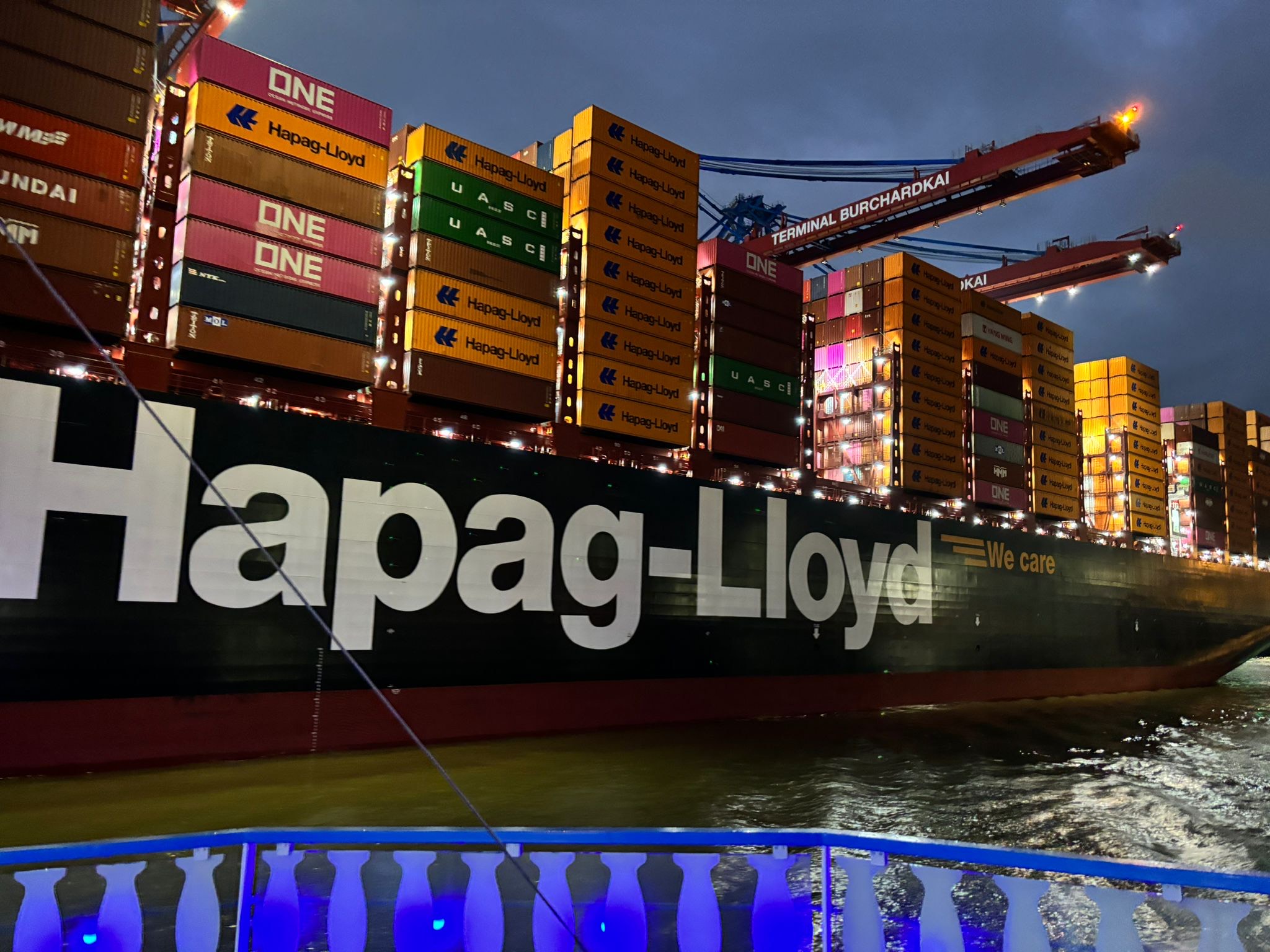
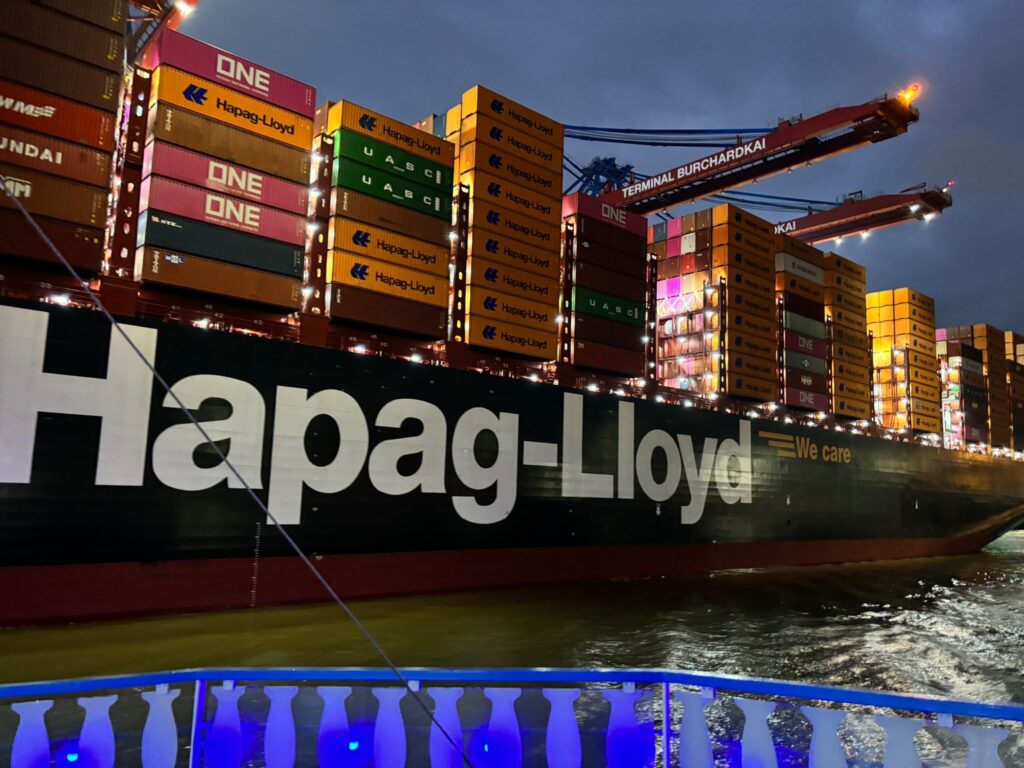
Photo credit: Preben Olsen
Germany’s container shipping firm Hapag-Lloyd has inked a $500m order with Chinese shipyard CIMC Raffles.
The Hamburg-based carrier has ordered eight 4,500-TEU container vessels, with deliveries set for 2028 and 2029. The investment volume amounts to more than $500m.
The ordered units will feature dual-fuel methanol engines, offering up to 30 percent greater efficiency than comparable older tonnage and the potential to cut as much as 350,000 metric tons of CO2e annually when using methanol propulsion.
The ships, which are part of Hapag-Lloyd’s first newbuild project involving this sustainable propulsion technology, will complement the growing portfolio of dual-fuel container ships in the company’s fleet: At present, a total of 37 dual-fuel liquefied natural gas (LNG) units that can also operate using biomethane are in operation or planned.
In addition, in April 2024, Hapag-Lloyd had already agreed with Seaspan Corporation to have five 10,100 TEU container ships converted to dual-fuel methanol propulsion in 2026 and 2027.
Moreover, in November 2024, Hapag-Lloyd had concluded an agreement with the Chinese energy producer Goldwind for the supply of 250,000 metric tons of green methanol per year.
Hapag-Lloyd also decided that another 14 newbuildings in the size classes 1,800 TEU (4 units), 3,500 TEU (6 units) and 4,500 TEU (4 units) will be chartered on a long-term basis. The ships will be delivered between 2027 and 2029.
In total the carrier is investing in 22 new ships in the segment with a capacity of less than 5,000 TEU.
“Continuously modernizing our fleet is firmly anchored in our Strategy 2030. The new ships will help replace older tonnage, further decarbonize the Hapag-Lloyd fleet, and reduce our dependence on the charter market. What’s more, operating these state-of-the-art ships will be much more cost-efficient,” said Rolf Habben Jansen, chief executive officer of Hapag-Lloyd AG.
With a fleet of 305 container ships and a total transport capacity of 2.5 million TEU, Hapag-Lloyd plans by 2030 to reduce the absolute greenhouse gas emissions of its fleet operations by around one third compared to 2022. The next target is to achieve net-zero fleet operations by 2045.