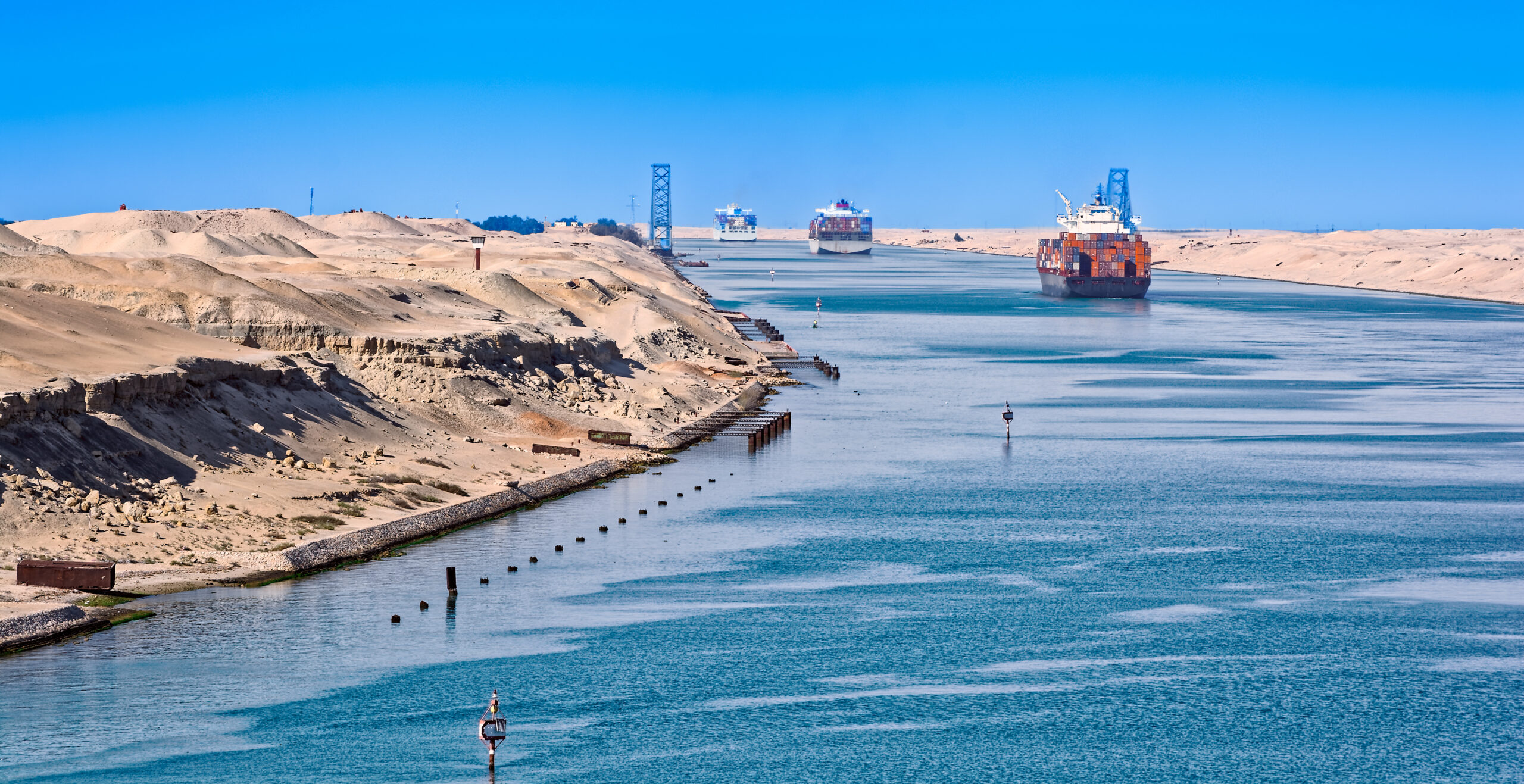
Suez Canal Authority (SCA) chairman and managing director Ossama Rabiee announced on Tuesday that liner giant A.P. Moller-Maersk will start routing its container vessels back through the Suez Canal in December as a first step toward a full return, following bilateral discussions that led to the signing of a new strategic partnership agreement.
While Danish shipping giant Maersk would be leading the way for the gradual return to the Red Sea, there is scepticism on the exact timing of such a move.
Hapag-Lloyd and A.P. Moller-Maersk have said they do not have specific timing to change the Gemini East-West network to sailing through the Red Sea, according to an update issued on November 26.
In response to “recent media coverage about the resumption of Gemini sailings through Suez / the Red Sea and the timing of such,” the Gemini partners Hapag-Lloyd and A.P. Moller-Maersk stated that Gemini’s “ambition has always been to return to a Suez-based East-West network once security conditions in the region permit,” but stressed that “the safety of crew, vessels and cargo remains our top priority,” and that they “currently have no specific timing to change the Gemini East-West network to sailing through the Red Sea.”
On the other hand, the canal’s administration announced in a statement posted in Arabic earlier on Tuesday: “The Suez Canal Authority and AP Moller-Maersk Group announced in a joint press statement the resumption of the group’s container ships transiting the Suez Canal starting from early December, paving the way for a full return.”
The move comes after cooperation between Maersk and the Suez Canal Authority, driven by a positive peace process in Gaza, which would establish freedom of navigation in the region.
The Maersk boss Vincent Clerk is encouraged by the peace developments in Gaza, which would eventually normalize shipping routes.
AP Moller-Maersk Group will take steps to resume navigation through the Red Sea via the Suez Canal “as soon as conditions allow,” with the safety of the crew as a top priority, according to CEO Vincent Clerc, as reported by Reuters.
On his part, Rabiee added that the strategic partnership agreement represents a cornerstone for the future of joint relations between the two sides, opening new horizons for cooperation across maritime and logistics sectors.
He also confirmed that discussions are underway with other major operators, including CMA CGM.
The SCA chairman told a press conference that the Sharm El-Sheikh Peace Summit promotes stability in the region and paves the way for the return of navigation to its normal levels. He stressed that the statistics of navigation in the channel witnessed many positive indicators during the months of October and November, amid expectations that the next period will see more improvement and recovery.
The head of the SCA revealed that the next period will see many companies conducting “intensive discussions” with the aim to modify their sailing schedules and the time for their return of their ships to the Red Sea.
Clerk stressed that the return of Maersk ships to the Suez Canal will be followed by the return of many other shipping lines.
The rerouting of ships away from the Suez Canal has significantly increased transit times, fuel costs, and insurance premiums, straining global supply chains and causing congestion at alternative routes.
The long-term normalization of Suez traffic remains tightly linked to geopolitics and maritime risk assessment, with analysts predicting a gradual recovery at best.