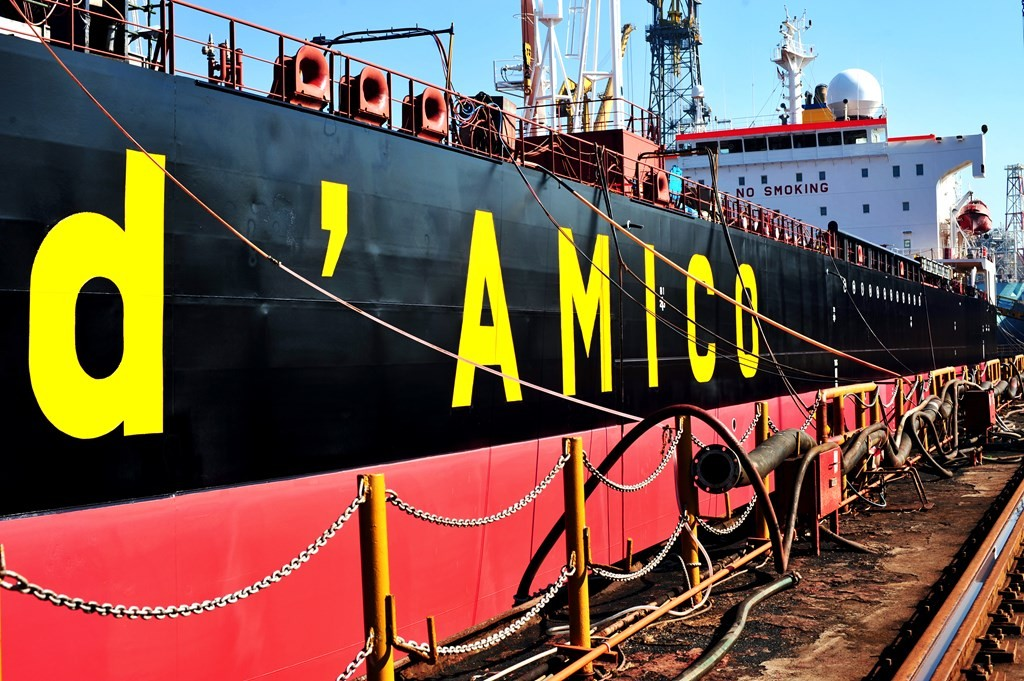
Italian product tanker operator d’Amico International Shipping S.A. has announced the increase of its time charter coverage at very profitable rates.
Since the beginning of the current year, d’Amico said that its operating subsidiary, d’Amico Tankers D.A.C. (Ireland), signed new time charter deals and extended certain existing agreements with counterparties at very profitable daily rates.
The company reported that time-charter contracts for one MR1 vessel were extended for 17 months. It added that a contract for one MR2 vessel terminating around November this year was extended for a further 15 months from that date.
New time charter contracts were signed for one MR1 and one MR2 for 12 months each. D’Amico also secured a new time charter contract for one LR1 for 24 months, with an option for the charterer at a higher rate, for further 12 months.
Following the conclusion of these deals, DIS reported that 54% of its available vessel days for FY 2026 are fixed at a TCE rate of approximately $23,492/day.
It also stated that 22% of its available vessel days for FY 2027 are fixed at a TCE rate of approximately $23,528/day, while 1% of its available vessel days for FY 2028 are fixed at a TCE rate of around $26,444/day.
Carlos di Mottola, chief executive officer of d’Amico International Shipping, said: “I am pleased to announce the conclusion of these agreements with highly reputable counterparties, including several long-standing customers, at very attractive and profitable rates.
“In line with our long-term commercial strategy, we continue to secure a balanced level of forward coverage by taking advantage of the current strength in the time-charter market, allowing us to lock-in a solid portion of our future earnings.
“We are now satisfied with the level of contract coverage for this year and look forward to benefit from the current strong markets on our vessels trading spot; the positive spillover effects from an extremely strong crude freight market, a rapidly ageing and increasingly sanctioned tanker fleet, the ongoing substantial growth in the supply of crude oil, as well as the inefficiencies associated with several trade disruptions and the recent geopolitical developments in Venezuela and potentially hard-to-forecast future ones in Iran, should continue supporting robust product tanker freight markets in the near-term.”