Greek prime minister Kyriakos Mitsotakis said Greece will not participate in any operation, after US president Donald Trump asked allies to send war ships to help restart shipping through the Strait of Hormuz.
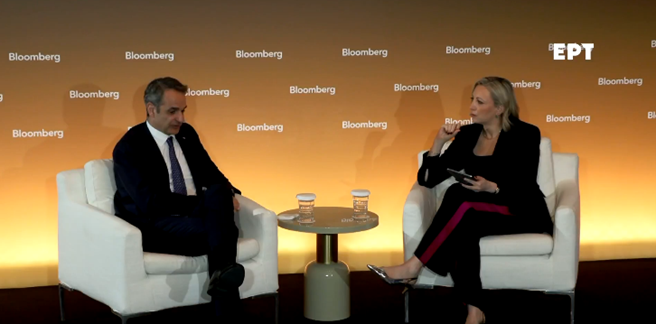
“The simple answer is no, Greece is not going to participate in any operation around the theater of current operations,” he said in the “Greek Energy: The New Era” conference organized by Bloomberg in Athens. “I doubt that there is much European willingness for such a mission right now.”
The prime minister referred to Greece’s support for the operation “Aspides”, pointing out that has not been fully supported by many other European countries.
Greece has consistently supported the EU operation “Aspides” with a mandate to protect freedom of navigation in the Red Sea and the Horn of Africa, though commenting that this has not been fully supported by all member states. He emphasized, however, that this is clearly defined geographically and does not extend to the Strait of Hormuz and the Persian Gulf.
At present, the prime minister said, only the Italians and we have naval assets in the area; perhaps the French will also participate.
Asked what Greece would reply if it got a direct “ask” to participate, the prime minister repeated that Greece will “not engage in actions in the wider region while military operations continue. Among us, as you know, there are top Greek shipowners who are very worried about what is happening in the wider region. But unless there is – and it is clear that there is no such prospect at the moment – a mission that will be approved by Europe, Greece will not participate on its own. And I believe that the likelihood of such a mission at this moment is very limited.”
He estimated that Europe will not participate militarily in the war against Iran but must focus on the economic consequences. He specifically emphasized that, at the European Council on Thursday, the member states should examine ways to address the economical and energy consequences of a prolonged war in the Middle East.
EU leaders are meeting in Brussels on 19-20 March where they will address the military escalation in the Middle East and the situation in Iran, including its consequences on the EU in terms of energy prices and energy security.
He also noted that this will be “a different story” if the crisis lasts a few weeks or if it drags on for months. Greece has been working actively for a rapid deescalation, he added. Greece does not consider that the issues in the Middle East can be resolved militarily, he said, but also does not consider that Iran should have nuclear weapons or threaten its closest neighbors.
Since the start of the crisis in the Middle East, Greece has extended its geopolitical and defence footprint to cover the needs of Cyprus, as well as responding to a request to assist in the air defence of Bulgaria, the prime minister noted.
“We were the first European country to send two frigates and four F-16 planes to respond to the call for help from our Cypriot brothers and at the same time we also responded to a request from our Bulgarian friends to help them with their air defence,” Mitsotakis said.
Mitsotakis repeated that Europeans must focus on managing the consequences of what could become a very major energy shock, adding that no one can predict the end of the conflict while expressing hope that it will not last long. “I urge Europe to have ready an action plan with short-term and medium-term measures, preferably decided at the level of leaders, in case we need to support businesses and consumers regarding energy prices,” he emphasized.