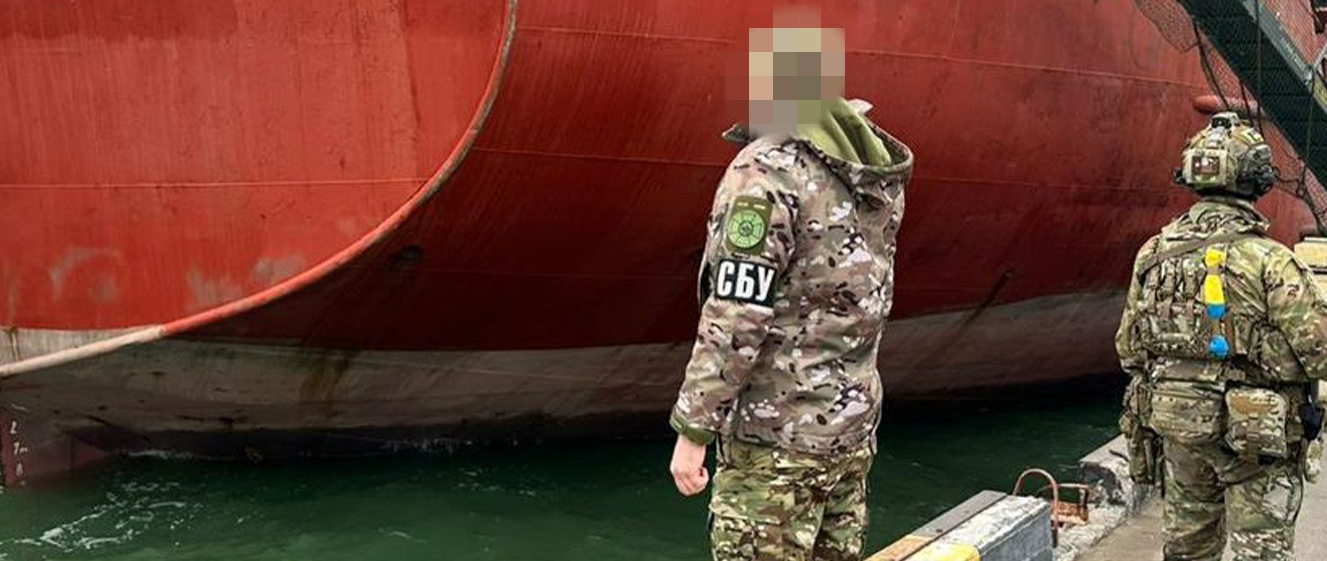
The suspected captain of the “shadow” vessel, which was detained in December 2025, faces up to five years in prison.
Under the procedural guidance of the prosecutor’s office, the captain of the Russian dry cargo ship was informed of suspicion of violating the procedure for entering and leaving the occupied Crimea.
After the vessel was detained in the Odesa port in December 2025, during searches and analysis of documents seized on board, the investigation established that it had previously made an illegal voyage to the occupied Crimea.
According to the investigation, it concerns a citizen of one of the Middle Eastern countries – the captain of a Russian dry cargo ship, which was detained in the Odesa seaport in December 2025.
Law enforcement officers detained and arrested in the Odesa port in December a Russian dry cargo ship that was accused of transporting Ukrainian agricultural products through the occupied Crimea.
As explained, Ukraine’s Security Service (SBU) located the ship in the commercial port of Odesa while attempting to export a batch of steel pipes under the flag of an African nation.
Authorities allege that prior to the full-scale war, the vessel called at Sevastopol at least seven times, where it engaged in exports of agricultural products for Russia’s benefit. The SBU asserts the ship loaded over 6,900 tons of Ukrainian wheat at the Sevastopol port in January 2021 and exported it to North Africa.
In December 2025, the ship, flying the flag of one of the African states, again arrived at the Odesa commercial port. As a result of joint actions by Ukrainian law enforcement, it was detained.
According to the SBU, searches on the vessel uncovered technical means and documentation containing evidence of calls to ports in occupied Crimea. Particularly, voyage plans, pilot cards, cartographic materials, and radio‑communication logs were found during the investigation.
Now, further evidence showed that the same master had entered Kerch in 2024. They report 2,000 tons of liquefied petroleum gas was loaded for delivery to one of the Middle Eastern countries, the prosecutor’s office indicated. They are further alleging that the master changed route data and periodically turned off the AIS system, which is used to track vessels.