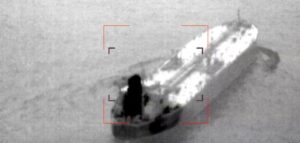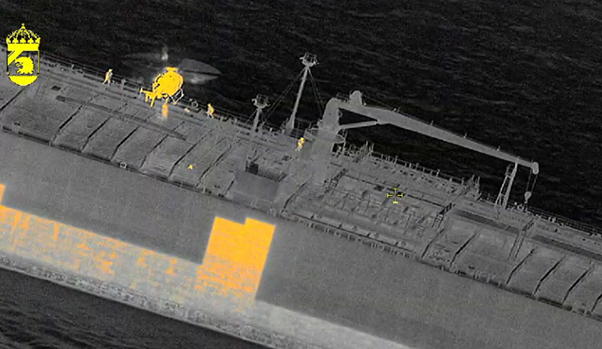
Swedish Transport Agency lifted an operating ban on an oil products tanker, after the authority’s confirmation that the vessel is now registered in Equatorial Guinea.
The tanker, which has been at anchor off Trelleborg since March, is allowed to leave its position and sail on as the Swedish Transport Agency has decided to lift the ban as of Oct. 12.
The Swedish Coast Guard, supported by police, boarded the 228-metre tanker (2007-built) off Trelleborg in the Baltic Sea on March 12.
It was reportedly sailing without cargo from Santos, Brazil, to Primorsk, when Swedish authorities boarded it over concerns about its flag status and documentation.
Russia’s embassy in Sweden said on March 14 that the tanker’s crew consists of 24 sailors, 10 of them Russian citizens, including the captain. The rest are Indonesian citizens.
Swedish authorities boarded the vessel on suspicion of lack of seaworthiness, a violation of maritime law.
Initially, the tanker was claiming registration in Comoros, which authorities found to be invalid.
In May, the agency said the ship reported reflagging to Cameroon but also failed verification.
The Swedish Transport Agency now says it has confirmed that the ship is registered in Equatorial Guinea, and that nothing on its side prevents departure.
The vessel remains on the EU sanctions list. The agency’s decision rests on registration and documentation. Where and when it sails next has not been announced.
Sweden’s coastguard stated that the vessel was not suspected of breaching sanctions.
Investigations involving two former captains, including allegations concerning false documentation, have been discontinued.
“It is positive that the ship can now leave Sweden after a remarkably long time at anchor off our coast,” said the Swedish Coast Guard’s deputy chief of operations, Daniel Stenling.
“We will intervene again against ships that are not seaworthy, or that do not behave in accordance with applicable international and national regulations,” he added.
During the spring, the Swedish Coast Guard, with the support of several Swedish authorities, carried out a number of interventions against ships that had committed violations of maritime law in Swedish territorial waters and in the Swedish economic zone.