Estonia, Latvia and Lithuania proposed a European Union ban on Friday on Russian grain exports through the bloc in a joint letter addressed to European Council president António Costa and European Commission president Ursula von der Leyen.
In the letter, the Estonian prime minister Kristen Michal, Latvian prime minister Andris Kulbergs and Lithuanian president Gitanas Nausėda stress that by attacking Ukrainian cargo ships, railways, and other vital trade routes, Russia is attempting to weaken Ukraine’s economy. At the same time, Russia is seeking new routes for its grain exports, including via the Baltic Sea.
The leaders argue that the European Union must not provide Russia with an opportunity to offset the economic consequences of its aggression.
They also state that the export of grain stolen from occupied Ukrainian areas through the EU must be prevented.
“Russia is bombing Ukrainian ports and blocking Ukrainian grain from reaching global markets, while seeking to earn revenue by transporting its own grain through the EU,” said Estonian prime minister Kristen Michal.
Michal plans to raise the issue at this week’s European Council meeting.
To support Ukrainian trade, the leaders call for the strengthening of the European Union-Ukraine Solidarity Lanes – transport connections designed to help Ukrainian goods reach the global market.
Estonia recently banned the transit of Russian and Belarusian grain through its territory. The decision was made against the backdrop of Russia’s war against Ukraine and attacks on Ukrainian ports.
As Estonia’s foreign minister Margus Tsahkna stated, Russia is attacking Ukrainian ports, blocking the export of Ukrainian grain, and seeking new routes to transport its own grain, but Estonia will not provide such a route.
He added that the Baltic countries are working together to ensure that their ports do not become a transit route for Russia.
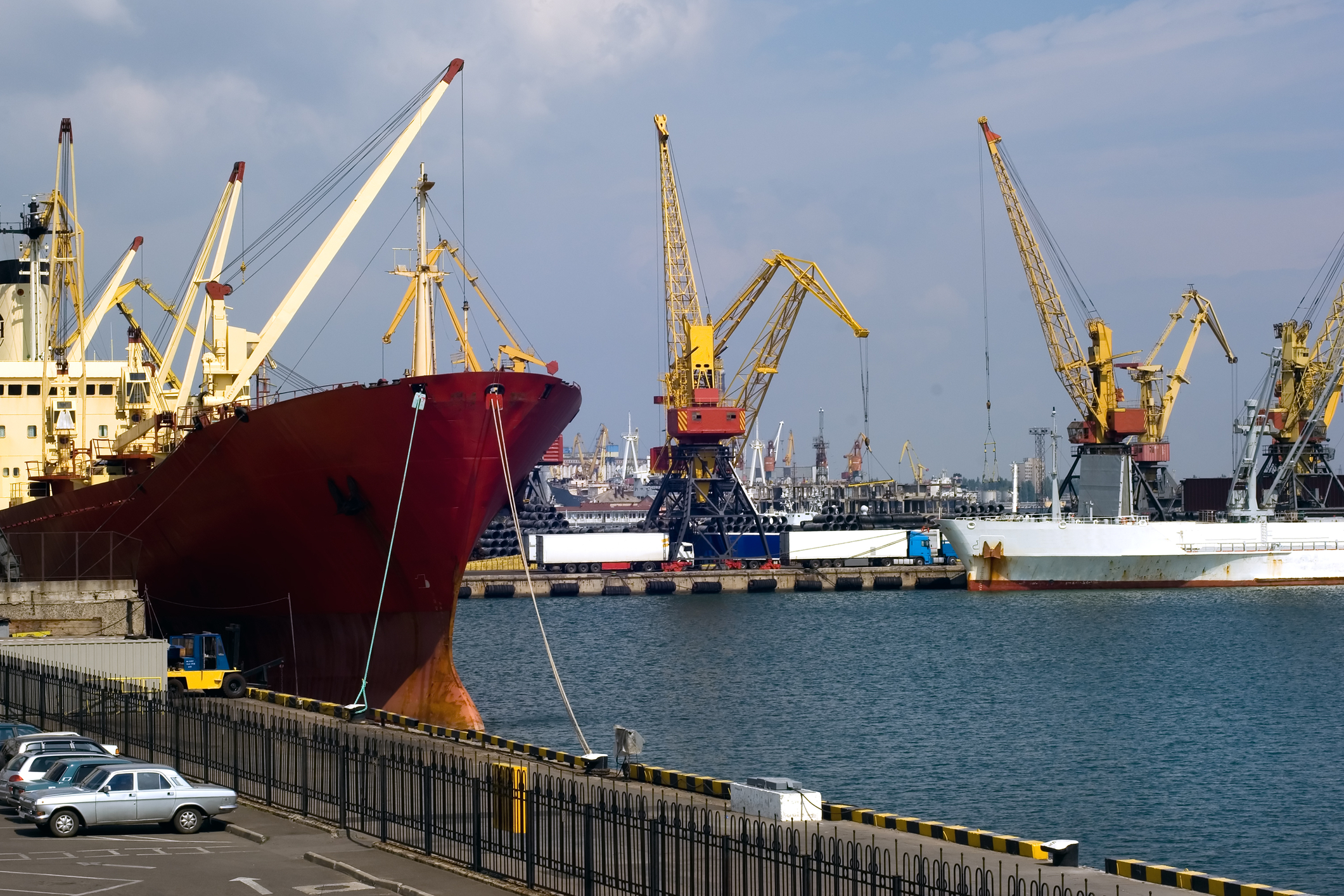
Russia’s attacks on Ukraine’s Black Sea ports have put at risk approximately 30 million tonnes of Ukrainian agricultural exports, worth nearly US$10bn, the Ukraine’s minister of agrarian policy and food Taras Vysotskyi said.
Alternative transport routes can handle only half of the required export volumes, posing risks to future sowing campaigns.
The restoration of maritime exports and efforts to combat the removal of Ukrainian grain from occupied territories were discussed during a meeting between Vysotskyi and Neil Crompton, Ambassador Extraordinary and Plenipotentiary of the United Kingdom to Ukraine.
The Ukraine’s minister of agrarian policy and food briefed the British delegation on the consequences of Russian attacks on port infrastructure and civilian vessels.
In June 2026, approximately 90% of Ukraine’s agricultural exports were shipped through the Black Sea ports of Odesa region. According to the ministry, cargo flows due to the deteriorating security situation have had to be redirected to rail and river transport routes, which are also subject to Russian attacks and have limited capacity.
Vysotskyi said the country needs to export approximately 60 million tonnes of agricultural products annually, or 5 million tonnes per month. However, rail and river routes can transport a maximum of 2.5 million tonnes per month.
“We have the capacity to store the current harvest, but the main challenge lies in the year ahead. If farmers are unable to sell their produce, they will lack the financial resources needed to continue production. This could lead to a reduction in the area under cultivation. Therefore, our immediate priority is to restore exports through the Black Sea ports,” Vysotskyi emphasised.
The minister noted that Ukraine, together with its international partners, continues to explore military and diplomatic options to restore the safe navigation in the Black Sea.
Another key topic of the meeting was combating the removal of Ukrainian grain from occupied territories. According to Vysotskyi, approximately 9.5 million tonnes of grain are produced annually in these territories.
In this context, the parties discussed the further implementation of the Grain Verification Scheme, a system developed by the UK that uses scientific methods to determine the geographical origin of grain.
Its implementation is expected to help identify Ukrainian agricultural products removed from occupied territories and prevent their sale on international markets.
The parties also explored opportunities to strengthen trilateral cooperation between Ukraine, the United Kingdom and Latvia, including finalising the preparation of a memorandum on cooperation in verifying the origin of grain.
Ukraine exported 2.4 million tonnes of agricultural products in September, or 46% of what should have been exported. Grain accounted for 1.4 million tonnes, or 38%, oilseeds for 444,000 tonnes, or 83%, vegetable oil for 311,000 tonnes, or 64%, and meal for 280,000 tonnes, or 46% of the potential required exports.
“By transport route, 1.3 million tonnes, or 54%, were exported through Danube ports; 993,000 tonnes, or 41%, by rail; and another 120,000 tonnes, or 5%, by road,” the ministry of agrarian policy and food reported.
“Without full access to the Black Sea ports, we effectively face an objective export limit of 45-50%. That is why it is critically important for Ukraine to preserve and expand alternative routes while also working with European partners to compensate for additional logistics costs,” Vysotskyi noted.