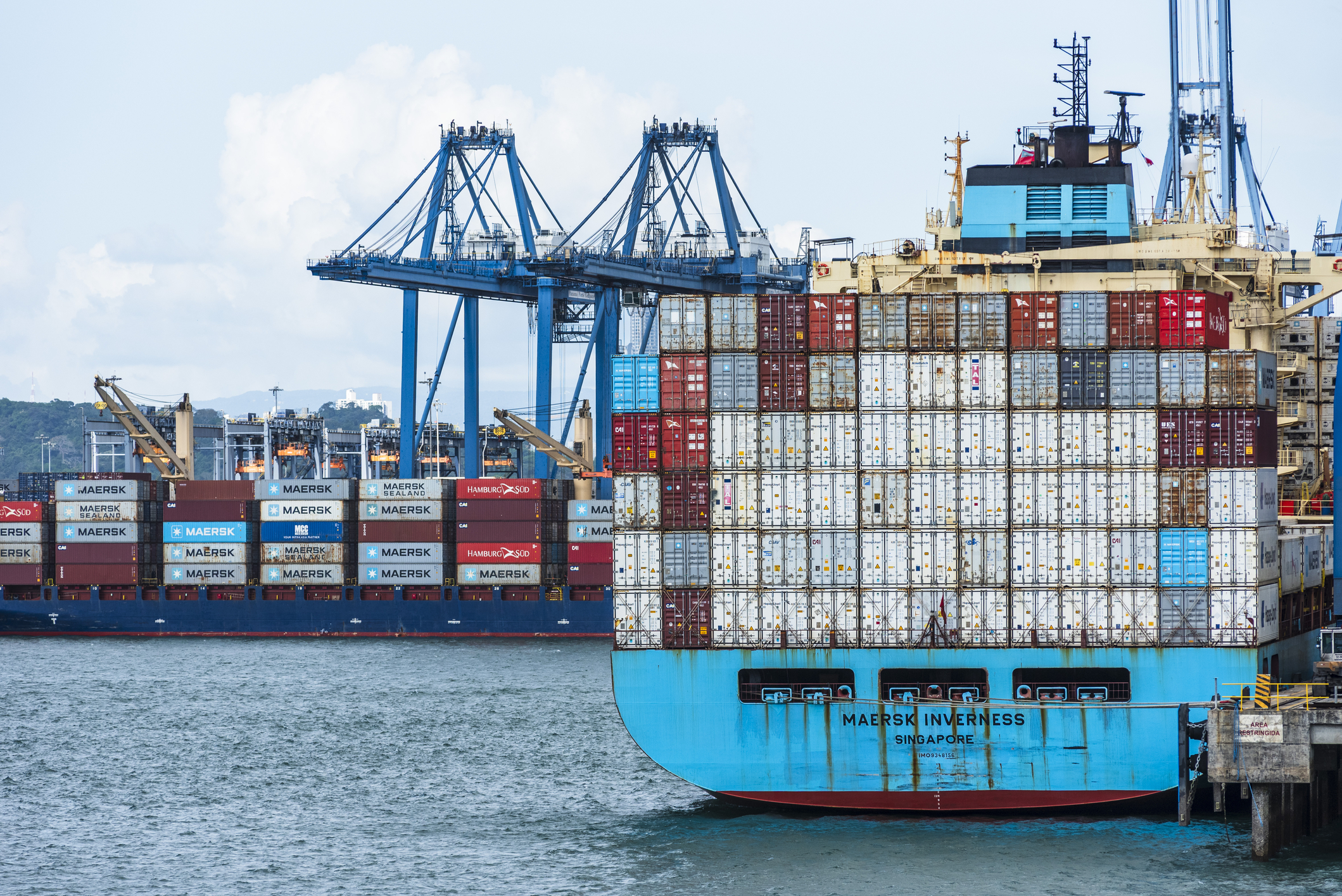
Maersk’s APM Terminals has signalled its willingness to temporarily take over the operation of Balboa and Cristobal ports in Panama after a court ruled against Panama Ports Company S.A. (PPC), a member of Hong Kong’s Hutchison Ports and operator of the Balboa and Cristóbal port terminals, declaring the concession granted to Panama Ports Company “unconstitutional.”
Following last week’s decision by Panama’s Supreme Court of Justice regarding the Balboa (Pacific) and Cristobal (Atlantic) terminals, the Panamanian State has activated a technical operational transition plan aimed at ensuring the continuity of port activities at the ports of Cristóbal (Atlantic) and Balboa (Pacific).
The Panama Maritime Authority (AMP) announced the changes on Friday, mentioning that the essential services that support the global logistics chain will continue to operate without disruption.
“In compliance with the applicable legal processes, the Government of the Republic of Panama will, in due course, rely on the specialized support of APM Terminals as a temporary administrator during a transition period. APM Terminals is among the world’s most trusted port operators, making it a suitable choice to assume this responsibility,” reads the statement.
On Friday, the APM Terminals -part of A.P.Moller-Maersk- confirmed its willingness to assume the temporary operation of both terminals.
The aim, it said, is to mitigate any risks that could impact essential services for regional and global trade and provide support to Panama’s logistics hub.
APM Terminals emphasized that any operational entry to the terminal will be carried out in full accordance with all legal requirements and procedures established by the law. According to APM Terminals, this can only take place once Panama’s Supreme Court of Justice ruling becomes final and binding.
In its announcement on Friday, the company made it clear that it is not involved in the ongoing legal proceedings “and bears no role in decisions regarding the short- or long-term structure or future administration of Balboa and Cristobal terminals,” adding that, “any action to be taken by APM Terminals will be guided by technical criteria, supply chain integrity, and the public interest.”
For its part, PPC -which runs the two port terminals under the concession contract since the 1990s- said on Thursday that the decision is inconsistent with the relevant legal framework and the law that approved the contract which has been the basis for PPC’s operations at the ports of Balboa and Cristóbal for nearly three decades.
The United States on Friday welcomed the decision, but Chinese foreign ministry spokesman said the decision “is inconsistent with the law of Panama that approved the concession, and the company will reserve all rights including to proceed legally.”
The spokesperson added that Beijing would take all necessary measures to safeguard the legitimate and lawful rights and interests of Chinese companies.