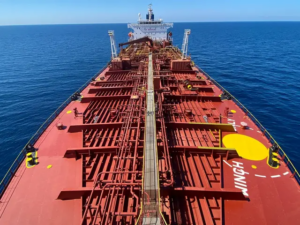
A Russian LNG tanker is currently adrift in the Mediterranean Sea after suffering a damage earlier this month.
Maritime authorities have warned mariners to steer clear of a crewless Russian tanker that has been drifting in the Mediterranean Sea after an alleged attack.
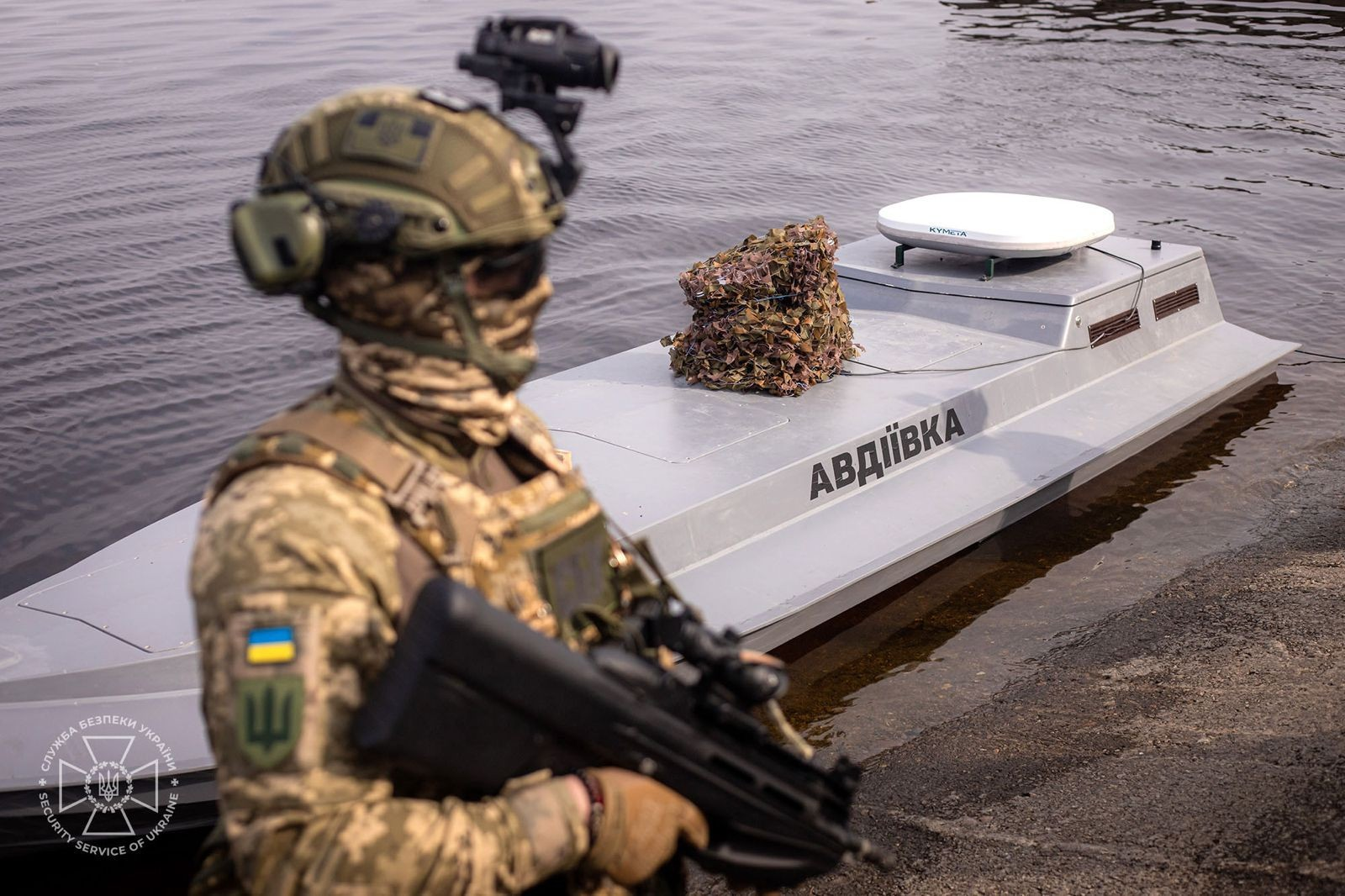
More specifically, according to information from the Russian foreign ministry, the vessel experienced an attack involving unmanned boats and drones near the shores of Malta. Russian ministry of Transport asserted that an attack by Ukrainian unmanned boats was to blame – although this has not been confirmed. The Ukrainian government has not commented on the Russian claim that Ukraine is behind it.
The vessel is unmanned (the crew evacuated after the attack, with emergency medical assistance provided to two sailors) and has sustained significant damage: explosions are audible on board, gas emissions have been detected, the lilt has increased, and localised fires are visible, according to Russian foreign ministry spokesperson Maria Zakharova, who called the alleged attack on the commercial vessel an “unprecedented terrorist attack.”
All 30 crew members have been rescued and are safe, the foreign ministry said.
At the time of abandonment, the bunker tanks contained fuel (450 tonnes of heavy fuel and 250 tonnes of diesel) as well as a substantial quantity of natural gas.
“As a responsible flag state, our country is monitoring the situation closely. The shipowner is tracking the tanker’s location. Russian authorities remain in contact with the shipowner and the relevant foreign agencies,” she said.
Spokesperson Zakharova said Russia’s further involvement in the situation, as the flag state, would depend on “specific circumstances.”
“International legal provisions applicable to the current situation assign responsibility to coastal states – so-called affected states – for resolving the issue of the drifting vessel and preventing an environmental disaster,” Zakharova said Monday in a statement.
“We await the legal classification of the incident involving the gas carrier by the Russian law enforcement agencies. Subsequently, we will consider additional steps, including within the framework of international law.”
During Monday’s EU Foreign Affairs Council in Brussels, Malta’s deputy prime minister Ian Borg raised concerns on the developing situation concerning the tanker.
He updated fellow foreign ministers on Malta’s continuous surveillance of the tanker since the incident earlier this month, as well as ongoing preparations and negotiations, in collaboration with Italy and other stakeholders, to ensure mariners’ safety and environmental protection in the area.
Dr Borg emphasised the need for the EU to explore measures to ensure that salvage operations by EU member states can proceed without the risk of exposing operators to third-party sanctions.
Comment by Russian Foreign Ministry Spokeswoman
At 4:25 a.m. local time on March 3, the Russian-flagged liquefied natural gas carrier, which was carrying 100,000 cubic metres of LNG and a crew of 30 Russian sailors, was attacked by maritime and aerial drones in neutral waters in the central Mediterranean Sea, 168 nautical miles southeast of the coast of Malta.
The vessel lost propulsion and power, resulting in a fire and gas explosion. All the sailors managed to evacuate the burning ship aboard a lifeboat. Thanks to the crew’s skilled and coordinated actions, any loss of life was avoided.
Ships with Russian crews operating in the region joined the search-and-rescue operation, with one locating the drifting lifeboat. By 8:30 p.m. local time that evening, all crew members had been rescued by an assisting tanker, which was to transport them to the nearest Russian port.
During the fire aboard the vessel, two crew members sustained severe burns. Consequently, a decision was made to evacuate them as a matter of urgency.
“With the active assistance of the Russian Embassy in Libya, the sailors received professional medical care and treatment for four days. After their condition stabilised and medical professionals deemed them fit for travel to Russia, the two injured crew members of the vessel were flown to the Russian Federation on a special flight on March 10 and admitted to hospital,” the statement of the spokeswoman reads.