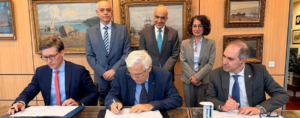

Italian shipbuilder Fincantieri said on Wednesday it had entered into a partnership with Generative Bionics, an Italian company focused on the development of autonomous humanoid robots, to develop a humanoid welding robot designed to operate alongside humans in the Group’s shipyards.
The collaboration integrates Fincantieri’s industrial expertise with the robotic platform developed by Generative Bionics, with the goal of increasing safety and operational efficiency, improving production quality and enhancing the sustainability of work in shipyards, according to Fincantieri’s announcement.
The humanoid robot will support specific welding activities in naval manufacturing.
It will be equipped with artificial intelligence, advanced manipulation, perception and vision capabilities for monitoring the welding seam, and optimized locomotion to operate in complex environments.
The collaboration program is expected to span a total of four years.
Initial on-site tests are scheduled by the end of 2026, with the objective of making operational functionalities available within the first two years, followed by further refinement, expansion, and industrial certification activities thereafter.
Development and testing activities will take place at Fincantieri’s Sestri Ponente shipyard, which will serve as the reference environment for industrial validation and certification of the technology.
The adoption of solutions based on Physical AI systems supports production continuity and assists workers in repetitive, physically demanding, or ergonomically challenging tasks.
“Advanced robotics and artificial intelligence applied to industrial processes represent a strategic lever for the evolution of shipbuilding and for the competitiveness of the European industrial system,” said chief executive officer and general manager of Fincantieri Pierroberto Folgiero.
“The collaboration with Generative Bionics is part of the transformation journey we are undertaking to strengthen our operational excellence, enhance the work of our people, and address in a structured way the challenges related to growing production complexity and the availability of specialized skills.”