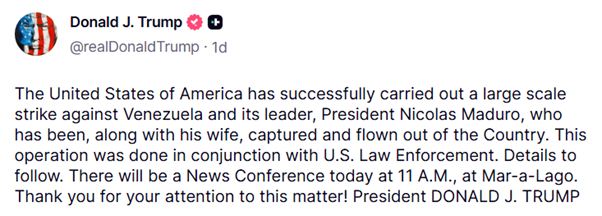
The United States confirmed that Venezuelan president Nicolás Maduro is now in U.S. custody following a military operation inside Venezuela.
Trump addressed the nation after a dramatic U.S. military operation in Caracas that led to the capture of the Venezuelan leader and his wife Cilia Flores.
US Attorney General Pamela Bondi said Maduro and his wife had been indicted in the Southern District of New York. Maduro has been charged with several offences, according to Bondi, including narco-terrorism conspiracy.
“They will soon face the full wrath of American justice on American soil in American courts,” Bondi wrote on X.
With Maduro now reportedly in U.S. custody, Venezuela’s oil future enters a new period. Trump said U.S. energy companies could play a central role in rebuilding the country’s oil sector.
As the United States weighs its next steps, Venezuela’s oil infrastructure will require billions of dollars.
Even under favourable political conditions, restoring Venezuela’s oil production would take time.
Speaking at a news conference on Saturday, Trump said “the oil business in Venezuela has been a bust, a total bust for a long period of time. They were pumping almost nothing by comparison to what they could have been pumping and what could have taken place.
“We’re going to have our very large United States oil companies, the biggest anywhere in the world, go in, spend billions of dollars, fix the badly broken infrastructure, the oil infrastructure, and start making money for the country.”
President Trump said the U.S. will be strongly involved in Venezuela’s oil industry, asserting that American companies will take a lead in rebuilding its petroleum infrastructure.
“We’re going to rebuild the oil infrastructure, which will cost billions of dollars,” Trump said. The cost will be “paid for by the oil companies directly,” but they will be “reimbursed,” he added.
But ramping up oil production would likely require time and sizable investments to modernize its industry, according to analysts, something that will also require a certain level of political stability.
Trump said in his public address that the U.S. would “run” Venezuela for the time being until a “safe, proper and judicious transition” occurs.
“We are going to run the country until such time as we can do a safe, proper and judicious transition,” Trump asserted. “We want peace, liberty, and justice for the great people of Venezuela, and that includes many from Venezuela that are now living in the United States and want to go back to their country. We can’t take a chance that somebody else takes over Venezuela that doesn’t have the good of the Venezuelan people in mind.”
In a wide-ranging press conference on Saturday, the president explained that the U.S. military was prepared to strike Venezuela again if needed.
“And we are ready to stage a second and much larger attack if we need to do so. So we were prepared to do a second wave if we needed to do so. We actually assumed that a second wave would be necessary, but now it’s probably not. The first wave, if you’d like to call it that – the first attack was so successful, we probably don’t have to do a second, but we’re prepared to do a second wave, a much bigger wave, actually. This was pinpoint, but we have a much bigger wave that probably won’t have to do.”
It is unclear exactly how the US plans to “run” Venezuela, but the president asserted it will be a “group” of people leading the charge.
When asked by reporters how he plans to “run” the country, he responded that “we’re designating various people. We’ll let you know who those people are. We’re going to run the country right, it’s going to be run very judiciously, very fairly.”
Following the capture of Maduro, the command of the country has fallen into the hands of vice president of Venezuela Delcy Eloína Rodríguez Gómez.
Venezuela’s Supreme Court has ruled that Rodríguez assume the duties and powers of the president following Nicolás Maduro’s removal by the United States.
Tensions between the two countries have been rising for months. They were ramped up significantly when the US launched strikes on boats allegedly transporting substantial amounts of narcotics bound for America.
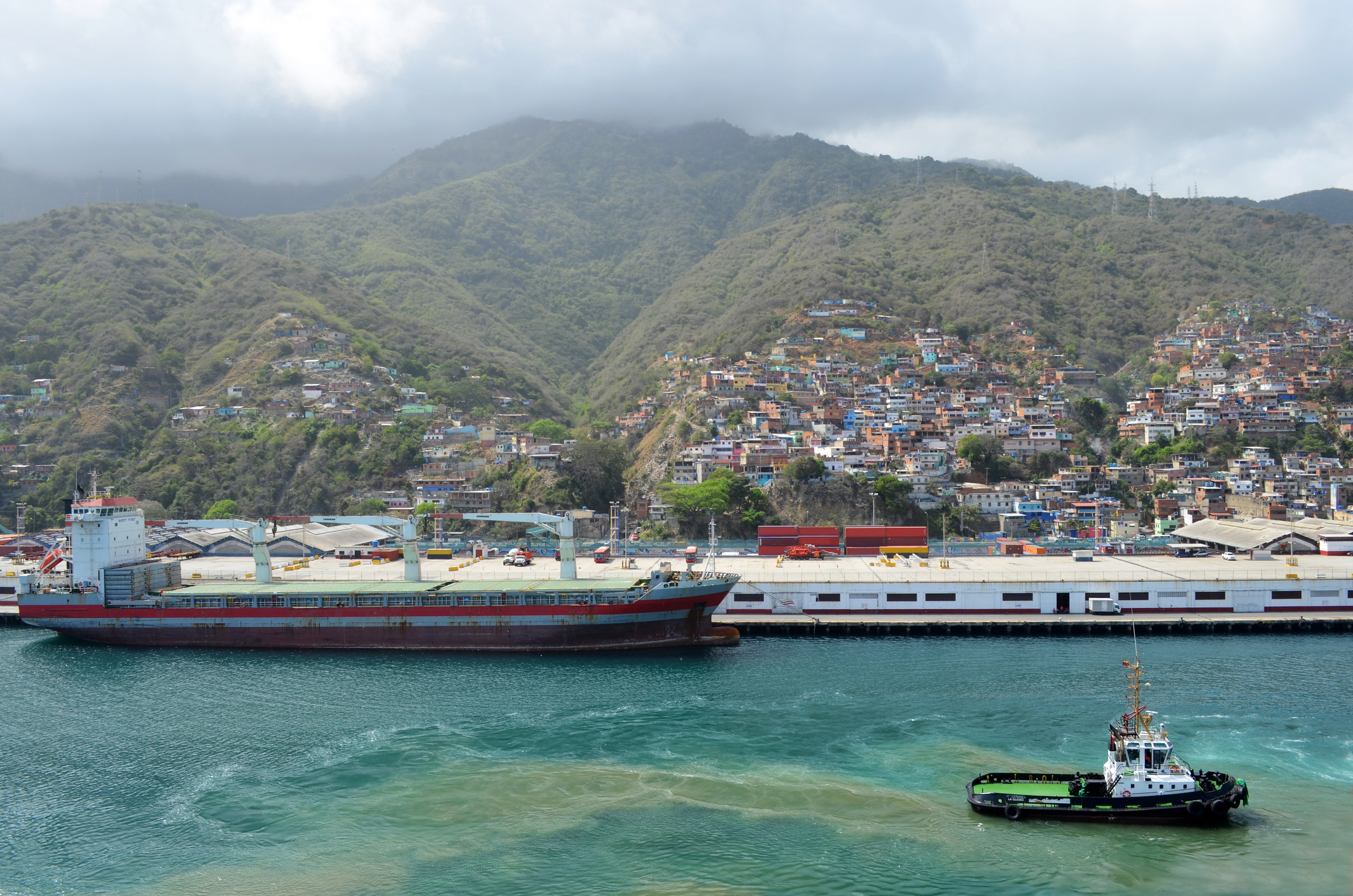
So far, the U.S. forces have seized two tankers off the coast of Venezuela and pursued a third vessel.
Venezuela’s allies have rushed to condemn the US military action. Iran and Russia spoke out strongly against the situation.
In a statement, Russia’s foreign ministry criticised what it called “an act of armed aggression” and said, “Venezuela must be guaranteed the right to determine its own future without destructive external interference, particularly of a military nature.”
“If such actions did in fact take place, they represent an unacceptable violation of the sovereignty of an independent state, the respect for which is a fundamental principle of international law,” they said.
Russian foreign minister Sergey Lavrov had a telephone conversation on January 3 with the vice president of Venezuela Delcy Eloína Rodríguez Gómez.
The officials spoke against further escalation so as to find a solution via dialogue.
During the conversation, the parties expressed mutual commitment to bolster up comprehensive strategic partnership between Russia and Venezuela.
Iran’s foreign ministry also condemned the US military attack on Venezuela, saying the action was a “blatant violation of the country’s national sovereignty and territorial integrity.”
Meanwhile, China expressed “shock” and also condemned such use of force.
European Union officials stopped short of condemning Trump’s actions and instead said they’re closely monitoring the situation.
“I have spoken with Secretary of State Marco Rubio and our Ambassador in Caracas. The EU is closely monitoring the situation in Venezuela,” wrote in a post on X Kaja Kallas, the EU high representative for foreign affairs and security policy. “The EU has repeatedly stated that Mr Maduro lacks legitimacy and has defended a peaceful transition. Under all circumstances, the principles of international law and the UN Charter must be respected. We call for restraint.”
European Commission President Ursula von der Leyen echoed Kallas’s statement.
“Following very closely the situation in Venezuela. We stand by the people of Venezuela and support a peaceful and democratic transition. Any solution must respect international law and the UN Charter.”
UK’s prime minister Keir Starmer said the UK has long supported a transition of power in Venezuela: “We regarded Maduro as an illegitimate President and we shed no tears about the end of his regime.”
French president Emmanuel Macron praised the U.S. removal of Venezuelan leader Maduro, but called for Maduro’s opponent Edmundo González Urrutia in Venezuela’s 2024 presidential election to “swiftly ensure this transition.”
The near-term impact on the price of oil is a bit of a guessing game, but Trump said the US would run the Venezuelan government for the time being.
American oil companies will want a stable regime in the country before they are willing to invest heavily. The infrastructure, on the other hand, does need significant investment.
— The White House (@WhiteHouse) January 3, 2026