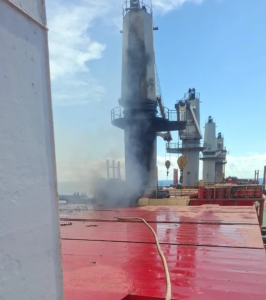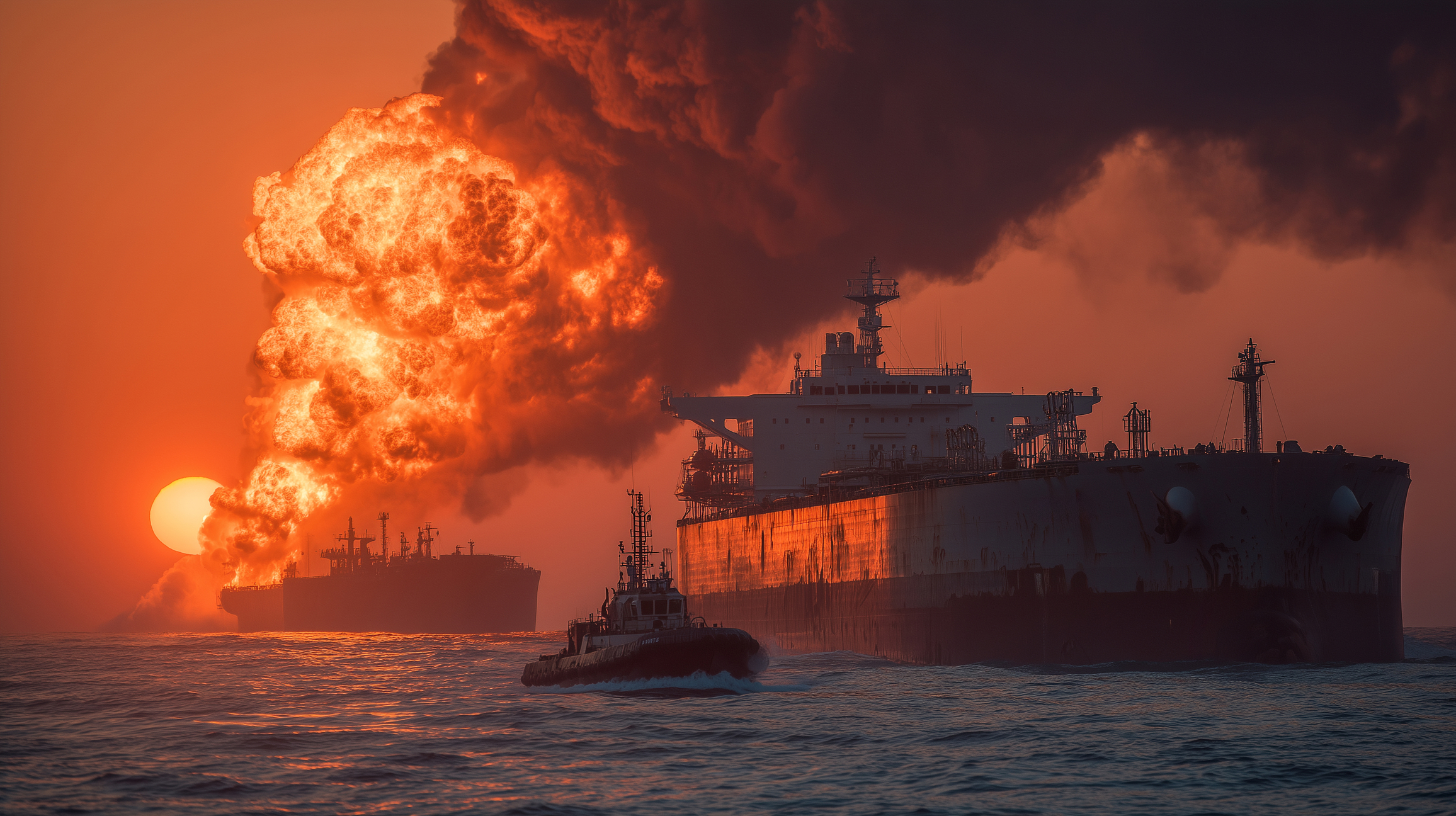
Iran’s foreign ministry condemned on Saturday a Ukrainian attack on an Iranian commercial vessel in the Caspian Sea, saying it resulted in an explosion that killed one sailor and injured another.
Tehran called the Saturday morning attack an act of aggression and said it would defend its national interests and security, while accusing Kyiv of seeking to expand the scope of war and insecurity.
Iran’s foreign ministry maintained that Iran has stayed out of the Russia-Ukraine conflict entirely.
The Islamic Republic “has never intervened in the Russia-Ukraine conflict,” it asserted.
“It is self-evident that responsibility for the consequences arising from the adventurism of the head of the Ukrainian regime rests with that regime and its supporters and instigators,” the Iranian foreign ministry said following the strike.
Iran’s foreign minister Abbas Araghchi on July 26 warned that his country would respond to a deadly attack by Ukraine on an Iranian ship in the Caspian Sea.
“Zelenskyy has attacked an Iranian commercial vessel, killing a sailor,” Araghchi wrote on X, describing it as “a blatant UN Charter violation done at Israel’s behest to drag Europe into its war.”
In calls with EU High Rep Kaja Kallas and Russian foreign minister Sergey Lavrov, made clear that “what the freeloader in Kyiv did CANNOT GO UNANSWERED.”
Iran’s denunciation of the Ukraine attack on the ship coincided with Ukrainian president Volodymyr Zelenskyy’s comments that Russia was passing its satellite observations in the Middle East to Iran to enable it to direct strikes in the region. Zelenskyy on Saturday said on X that Ukraine had “achieved very strong results with long‑range strikes in the Caspian Sea – including vessels used in military cargo shipments involving Iran, as well as a warship.”
Zelenskyy later claimed that Moscow has been coordinating with Tehran to provide satellite imagery of the Gulf states and U.S. military facilities amid the U.S.-Iran war.
“Since the beginning of July, we have recorded active Russian satellite surveillance of the Gulf states and U.S. military facilities located there. These images subsequently appear in Iran,” Zelenskyy said.
“There is a clear correlation between Russia’s satellite imagery of these sites and Iranian strikes – both before the attacks, in preparation for them, and afterward, to assess the damage inflicted. On July 19 and 20 alone, four air bases fell within the area of interest of Russian satellites – two in Bahrain, one in Jordan, and one in Kuwait. The purpose is clear,” the president added.
Ukraine’s Security Service (SBU), for its part, reported that drone attacks had been carried out on July 25 in the Caspian Sea against “cargo ships that are under international sanctions and were used to transport military cargo between Iran and Russia.”