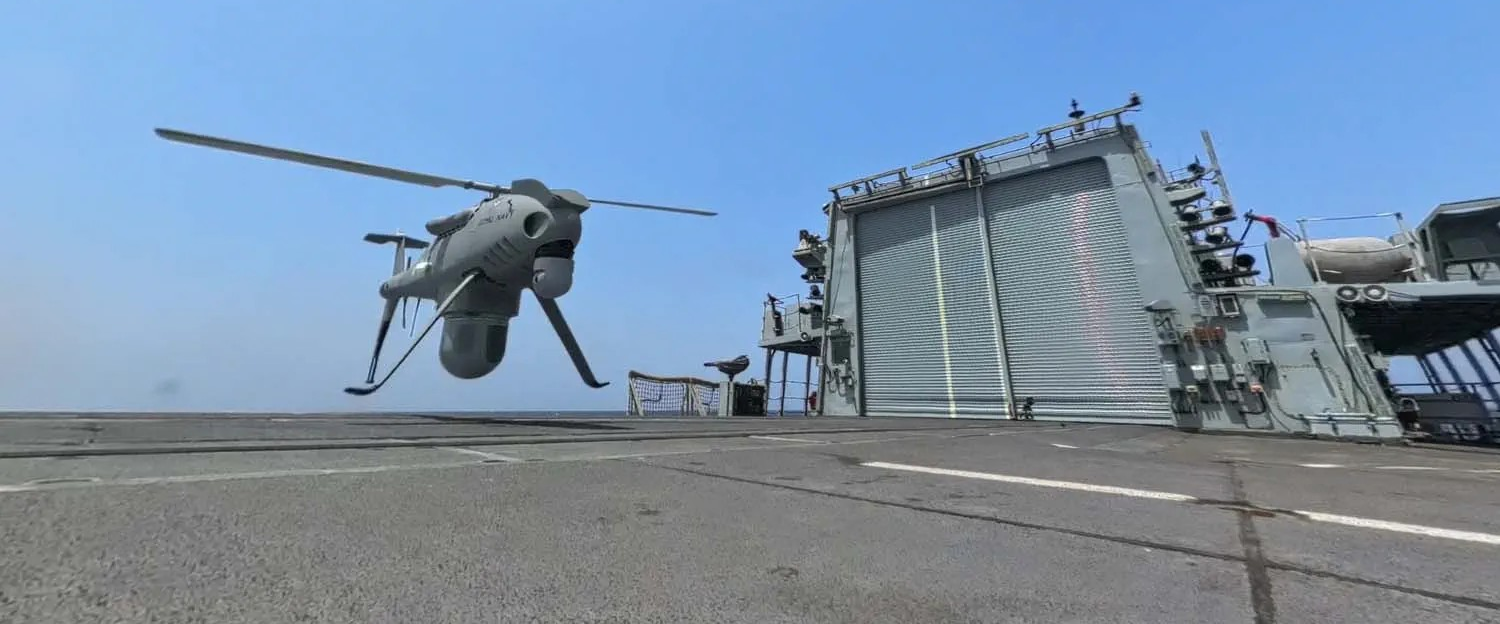
The lightning-fast reflexes of a Royal Navy drone pilot prevented a £2.5m Peregrine drone sinking in the Gulf. He took control of the mini helicopter a split second from crashing and landed it safely on HMS Lancaster.
Lieutenant Commander Adrian ‘AJ’ Hill grabbed the controls and steered the Peregrine mini helicopter to safety, earning him the first aircrew commendation for a drone operator.
‘Green Endorsements’ are the highest awards for safety in both the Fleet Air Arm and Royal Air Force – but until Lt Cdr Hill’s exploits no drone pilot had been decorated with one.
The 10-foot-long surveillance drone was hovering in autonomous mode at 60 feet, just off the stern of HMS Lancaster at the end of an otherwise routine 2½ hour patrol, scouring the Gulf of Oman for potential drug traffickers.
Hill, a flight commander with 700X Naval Air Squadron, said: “It went very low. It was only about one to two feet from the sea. A quarter of a second later it would have touched – and if it’s in the sea then it’s ‘game over’.”
The Peregrine, the name given by the navy for the 200-kg S-100 ‘camcopter’ developed by Schiebel with additional military sensors/system installed for operations, suddenly suffered a computer error and began to plunge towards the water.
Luckily, its operators were already in position, preparing to land the drone manually.
“Almost out of the corner of my eye – I saw it suddenly descending,” said Lt Cdr Hill. “It was only a few seconds from crashing into the sea.
“I had to take manual control – that’s pressing three buttons in the right order – and ‘full-up’ on the controls.
“After that I got it to a safe height, collected my thoughts, and manually put it on the deck. It was one of my best landings, as the adrenaline was pumping.”
The only two people to witness Lt Cdr Hill’s rapid response were two engineers from the Culdrose-based drone squadron who had been observing the landing – and were as surprised as he was by the £2.5m Peregrine’s sudden drop in altitude.
“You can’t train for this type of emergency, but I knew what I needed to do. This was just reaction – and not panicking,” the officer said.
“Peregrine was still in its testing phase while we were flying it from Lancaster so the fact we had some difficulties is not unusual.”
He was presented his endorsement by the head of the Fleet Air Arm, Rear Admiral Anthony Rimington.
The citation says there is no doubt that Lt Cdr Hill, a trained drone pilot as well as a helicopter airborne surveillance and control observer, demonstrated exceptional professional skill, with a sharp eye and quick reactions.
It reads: “Although this incident did not present a risk to life, it did pose a significant risk to equipment and operational capability.”