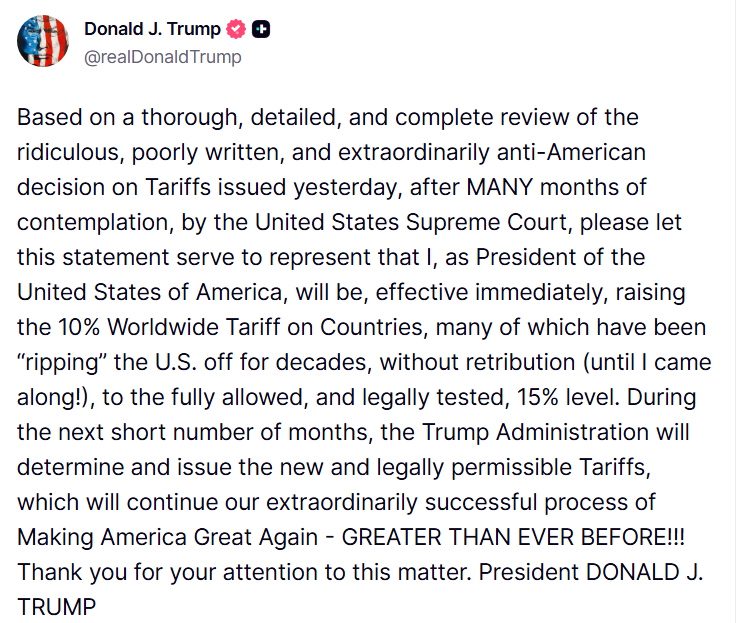
The Supreme Court’s ruling on the legality of US president Trump’s tariffs has been a significant event in the political and economic landscape. President Donald Trump said on Saturday that he will increase the ‘global tariff’ he imposed a day earlier to 15% from 10% following an adverse ruling at the Supreme Court.
The announcement came after Trump lashed out at the Supreme Court on Feb. 20 over what he called its “deeply disappointing” decision.
Trump said in a Truth Social post that “effective immediately,” he would be “raising the 10% Worldwide Tariff on Countries … to the fully allowed, and legally tested, 15% level.”
The president went on to say that his administration would “determine and issue the new and legally permissible Tariffs, which will continue our extraordinarily successful process of Making America Great Again.”
Analysts say Trump still has options to keep taxing imports even after the adverse ruling of the Supreme Court.
Trump plans to invoke new trade authorities in response to Friday’s Supreme Court ruling on tariffs.
Here are some of which the president mentioned on Friday in a post on his Truth Social: “Although I firmly disagree with the Court’s holding today, the decision might not substantially constrain a President’s ability to order tariffs going forward. That is because numerous other federal statutes authorize the President to impose tariffs and might justify most (if not all) of the tariffs issued in this case…Those statutes include, for example, the Trade Expansion Act of 1962 (Section 232); the Trade Act of 1974 (Sections 122, 201, and 301); and the Tariff Act of 1930 (Section 338).”
In its 177-page opinion released on Friday, the Supreme Court said: “The President asserts the extraordinary power to unilaterally impose tariffs of unlimited amount, duration, and scope. In light of the breadth, history, and constitutional context of that asserted authority, he must identify clear congressional authorization to exercise it.
“IEEPA’s grant of authority to “regulate…importation” falls short. IEEPA contains no reference to tariffs or duties.
“The Government points to no statute in which Congress used the word “regulate” to authorize taxation. And until now no President has read IEEPA to confer such power.
“We claim no special competence in matters of economics or foreign affairs. We claim only, as we must, the limited role assigned to us by Article III of the Constitution. Fulfilling that role, we hold that IEEPA does not authorize the President to impose tariffs.”
The Supreme Court’s ruling Friday is not the end of President Donald Trump’s tariffs. Before the ruling, experts said that Mr. Trump could quickly find other avenues to tax imports.
Writing on Truth Social on Friday, Trump said: “The Good News is that there are methods, practices, Statutes, and other Authorities, as recognized by the entire Court and Congress, that are even stronger than the IEEPA TARIFFS, available to me as President of the United States of America and, in actuality, I was very modest in my “ask” of other Countries and Businesses because I wanted to do nothing that could sway the decision that has been rendered by the Court.
“TARIFFS have, likewise, been used to end five of the eight Wars that I settled, have given us Great National Security and, together with our Strong Border, reduced Fentanyl coming into our Country by 30%, when I use them as a penalty against Countries illegally sending this poison to us. All of those TARIFFS remain, but other alternatives will now be used to replace the ones that the Court incorrectly rejected. Based on longstanding Law and Hundreds of Victories to the contrary, the Supreme Court did not overrule TARIFFS, they merely overruled a particular use of IEEPA TARIFFS.
“Therefore, effective immediately, all National Security TARIFFS, Section 232 and existing Section 301 TARIFFS, remain in place, and in full force and effect. Today I will sign an Order to impose a 10% GLOBAL TARIFF, under Section 122, over and above our normal TARIFFS already being charged, and we are also initiating several Section 301 and other Investigations to protect our Country from unfair Trading practices.”
However, Trump said Saturday that he wants a worldwide tariff on countries of 15%, up from 10% he had announced a day earlier.
Trump about Tariff Refunds: “We’ll end up being in court for the next five years”
Before the decision, analysts said that a loss in the case could force the government to potentially pay hefty refunds. However, the Supreme Court’s ruling did not make clear whether the Trump administration will have to refund billions in tariffs already collected by the government.
In the court’s ruling it is stated that, “The Court’s decision is not likely to greatly restrict Presidential tariff authority going forward. But the Court’s decision is likely to generate other serious practical consequences in the near term. One issue will be refunds. Refunds of billions of dollars would have significant consequences for the U. S. Treasury. The Court says nothing today about whether, and if so how, the government should go about returning the billions of dollars that it has collected from importers.”
The justices, in their ruling, did not order the Trump administration to provide refunds for the tariffs already paid, or spell out how repayment should work.
“They take months and months to write an opinion and they don’t even discuss that point. We’ve taken hundreds of billions of dollars and what happens to that money? They don’t even talk about that,” Trump told reporters on Friday during a press conference.
Asked directly whether he planned to offer refunds, the president replied: “I told you the answer, it’s not discussed [in the ruling]. We’ll end up being in court for the next five years.”