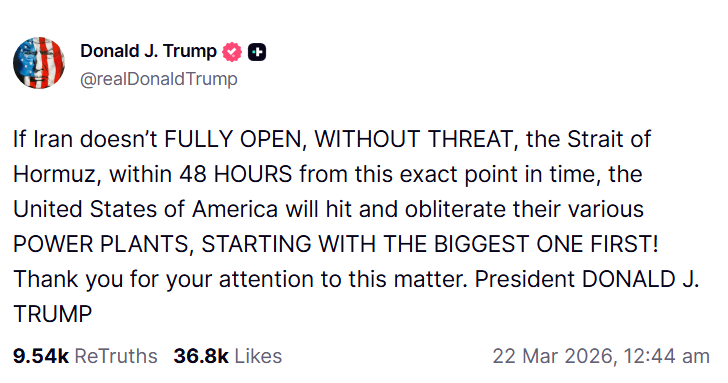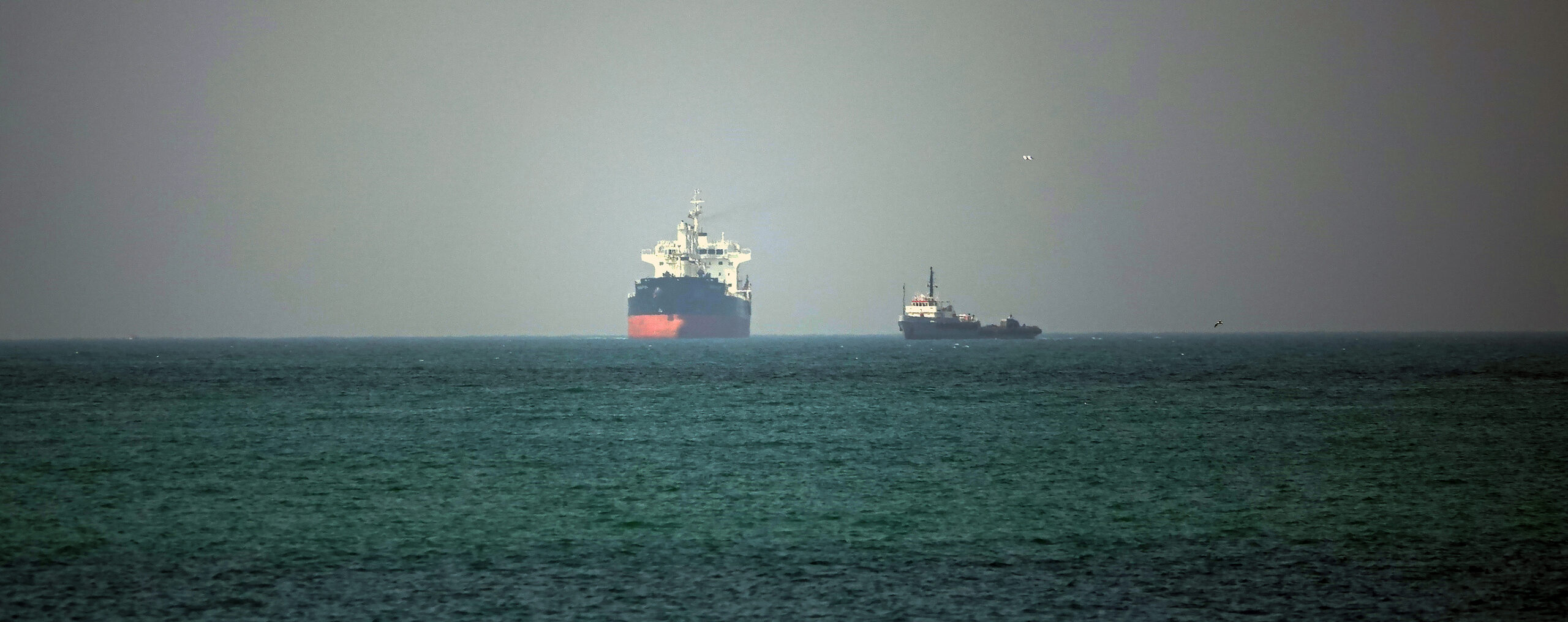
US president Donald Trump issued a stark ultimatum during the weekend, threatening to destroy Iranian power plants if Tehran does not fully open the Strait of Hormuz within 48 hours.
“If Iran doesn’t fully open, without threat, the Strait of Hormuz, within 48 hours from this exact point in time, the United States of America will hit and obliterate their various power plants, starting with the biggest one first,” Trump wrote on Truth Social.
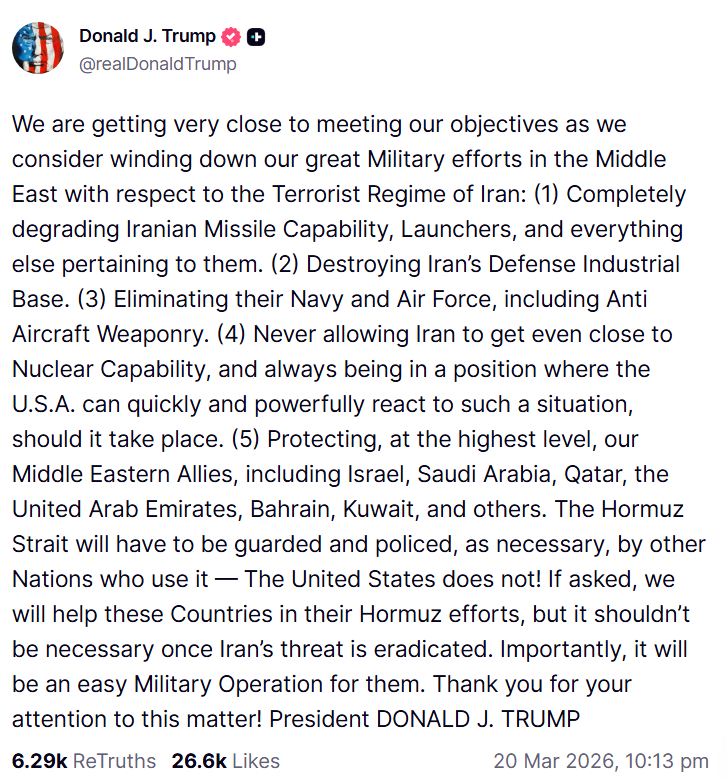
Earlier, Trump said the US is considering winding down its military efforts in the Iran war as his administration was close to meeting its objectives, but that other nations must guard the Strait of Hormuz.
In a post on Truth Social, the US president also called on countries that use the Strait of Hormuz to guard and police it “as necessary.”
Listing the objectives, he said the US was close to degrading Iran’s missile and launcher capability, destroying its defence industrial base, and eliminating the Iranian navy and air force.
He said it was also close to “never allowing Iran to get even close to Nuclear Capability, and always being in a position where the U.S.A. can quickly and powerfully react to such a situation, should it take place.
“Protecting, at the highest level, our Middle Eastern Allies, including Israel, Saudi Arabia, Qatar, the United Arab Emirates, Bahrain, Kuwait, and others.”
Turning to the Strait of Hormuz, Trump then said it “will have to be guarded and policed, as necessary, by other Nations who use it – The United States does not! If asked, we will help these countries in their Hormuz efforts, but it shouldn’t be necessary once Iran’s threat is eradicated. Importantly, it will be an easy Military Operation for them.”
UK approves US use of bases to strike Iranian missile sites targeting Hormuz
Earlier, the UK has given Donald Trump the green light to use British bases to strike Iranian missile sites targeting the Strait of Hormuz.
Ministers met to discuss the latest developments on Friday afternoon where they reached the new agreement, Downing Street said.
A spokesperson said: “Ministers condemned Iran’s expansion of its targets to include international shipping. They agreed that Iran’s reckless strikes… risked pushing the region further into crisis and worsening the economic impact being felt in the UK and around the world.
“They confirmed that the agreement for the US to use UK bases in the collective self-defence of the region includes US defensive operations to degrade the missile sites and capabilities being used to attack ships in the Strait of Hormuz.”
The development came after Mr Trump had earlier launched a fresh attack on NATO allies, calling them “cowards” as he claimed they had failed to help reopen the Strait of Hormuz, after Iran blocked the passage of shipping vessels.
Trump dubs NATO a ‘paper tiger’ over Strait of Hormuz
Trump referred to the North Atlantic Treaty Organization (NATO) as “a paper tiger” and “cowards” over Europe’s stance to not support securing the Strait of Hormuz as the U.S. and Israel continue striking Iran.
“Without the U.S.A., NATO IS A PAPER TIGER!” Trump wrote in a Truth Social post.
“They didn’t want to join the fight to stop a Nuclear Powered Iran. Now that fight is Militarily WON, with very little danger for them, they complain about the high oil prices they are forced to pay, but don’t want to help open the Strait of Hormuz, a simple military maneuver that is the single reason for the high oil prices. So easy for them to do, with so little risk,” Trump continued.
Iranian FM warns UK is “putting British lives in danger”
Iran’s foreign minister, Abbas Araghchi, appeared to put the UK in the firing line as he criticised Starmer’s decision to allow US forces to use British bases to launch attacks on Tehran.
Araghchi has accused UK’s prime minister Keir Starmer of “putting British lives in danger” over the UK’s agreement to let the US use British bases to strike Iranian missile sites targeting the Strait of Hormuz.
He warned Iran will “exercise its right to self-defence.”
Posting on X, Araghchi said: “Vast majority of the British People do not want any part in the Israel-U.S. war of choice on Iran.
“Ignoring his own People, Mr. Starmer is putting British lives in danger by allowing UK bases to be used for aggression against Iran.”
World Trade Organization issues warning about global merchandise trade
The World Trade Organization issued a warning Thursday that global merchandise trade volume growth would drop from 4.6% in 2025 to 1.9% in 2026 before picking up to 2.6% in 2027. WTO economists warn that the ongoing conflict in the Middle East could further reduce trade growth if energy prices remain elevated, noting that it would also put pressure on food supplies and services trade due to travel and transport disruptions.
Before the start of the current Middle East conflict, merchandise trade growth had been expected to slow to 1.9% this year before picking up to 2.6% next year. However, if the oil price shock stemming from the conflict proves to be durable, world merchandise trade volume growth could slow to 1.4% this year before picking up by 2.8% next year.
The Strait of Hormuz blockade has disrupted fertilizer supplies critical to global agriculture, with around one-third of the world’s fertilizer exports normally passing through the waterway. Major agriculture producers like India, Thailand and Brazil depend on the Gulf for 40%, 70% and 35% of their urea imports respectively. Gulf states face a food security challenge as well, with import dependency averaging 75% for rice and exceeding 90% for corn, soybeans and vegetable oil – commodities that would face higher costs through alternative routes.
Disruptions in the Strait of Hormuz – traffic has fallen from 138 vessels per day to almost zero since the beginning of the conflict in the Middle East – have already triggered a surge in energy prices and increases in transport and insurance costs, which may contribute to broader inflationary pressures.
WTO director-general Ngozi Okonjo-Iweala said: “Sustained increases in energy prices could increase risks for global trade, with potential spillovers for food security and cost pressures on consumers and businesses.”
India’s FM spokesperson says several seafarers returned or will be arriving in India
India’s external affairs ministry spokesperson Randhir Jaiswal told a weekly media briefing on Friday that almost 22 ships with 611 seafarers are currently in the region.
Jaiswal added: “In addition, we also have seafarers across the region. We are in touch with their companies. We are also trying our best how best we can support them in terms of essentials, so on and so forth. Several seafarers have also come back. For example, the 15 seafarers, some of whom were injured, who were housed in Basra, they have come back to India or will be arriving in India shortly. Similarly, seafarers from other parts of that region have also been coming back.”