The UK government will deploy a Royal Navy type 45 air defence destroyer and one of the most advanced warships in the world to bolster security around RAF Akrotiri in Cyprus following the drone attack on the RAF base in Akrotiri earlier this week.
Keir Starmer informed the president of Cyprus Nikos Christodoulides of the UK’s decision to deploy HMS Dragon to Cyprus.
The British prime minister said the Royal Navy type 45 air defence destroyer will be sent to the region as the US-Israel war with Iran continues to spiral.
The UK government will deploy the Royal Navy warship to the eastern Mediterranean to bolster security around RAF Akrotiri in Cyprus.
Earlier on Tuesday, it had been speculated that HMS Duncan might be deployed to the area, but Sir Keir confirmed on X that HMS Dragon would be sent.
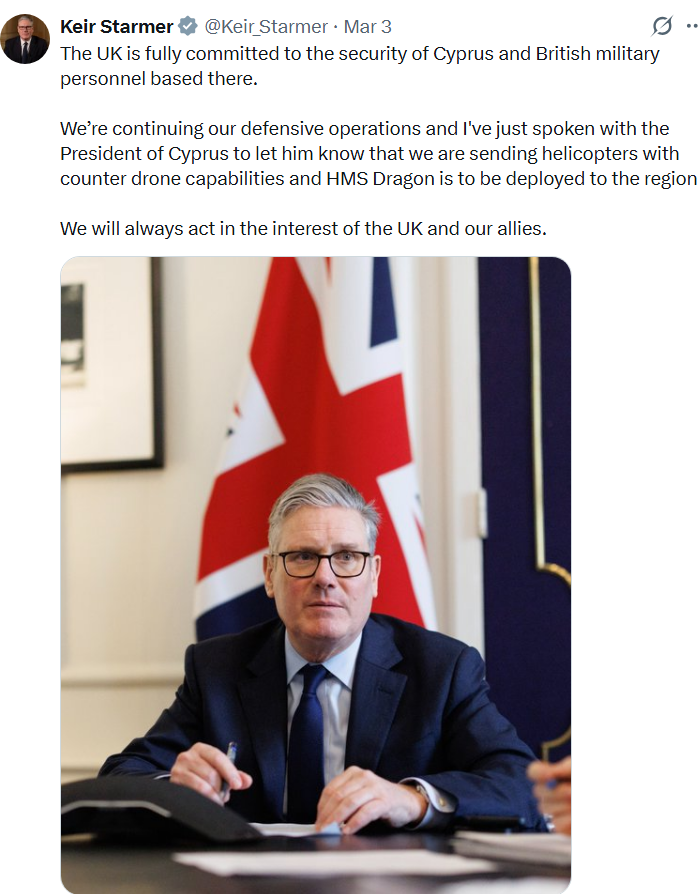
“The UK is fully committed to the security of Cyprus and British military personnel based there. We’re continuing our defensive operations and I’ve just spoken with the President of Cyprus to let him know that we are sending helicopters with counter drone capabilities and HMS Dragon is to be deployed to the region,” he said.
“We will always act in the interest of the UK and our allies.”
In addition to the ongoing defensive operations undertaken by the UK, he confirmed the UK will deploy two Wildcat helicopters later this week. These helicopters will provide more counter-drone capability to hunt and shoot down any further threats, he added.
In an oral statement to the House of Commons on Iran on March 2 Starmer noted: “Our Armed Forces have also come under pressure. Last night, at RAF Akrotiri in Cyprus, an Iranian drone struck within 800 yards of British personnel. Thankfully, there were no casualties. It is important for me to be clear: our bases in Cyprus have not been used by US forces for offensive strikes.”
When the governmental spokesman of Cyprus Konstantinos Letymbiotis asked on Wednesday which allied forces, beyond Greece, are present to support the defensive safeguarding of Cyprus, the spokesman said: “The countries which have responded positively, and which we duly thank for their support, to the precautionary measures we are taking include, first and foremost, Greece. The two F-16 aircraft arrived that same afternoon, following the telephone conversation between the President of the Republic of Cyprus and the Prime Minister of the Hellenic Republic. In addition, two frigates of the Hellenic Navy have also arrived.
“France, certainly, and president Emmanuel Macron himself last night announced the assistance decided upon by the French Republic. As is well known, we are also in contact, with an in-principle positive response from Germany and Italy. Naturally, they have their own internal procedures.”
In response to a question, the spokesman stated that the UK is providing assistance; however, this is being done on the basis of its own assessment and not in response to a request from Cyprus, nor following any prior consultation. He added that this was conveyed by the UK prime minister to the president of Cyprus during their telephone conversation.
When asked whether the issue of re-evaluating the status of the British Bases remains on the table, the spokesman said: “We have conveyed our positions. Our position has not only been respected: you can see that the statements being issued by the United Kingdom are in full alignment and grounded in the same spirit. What is paramount is that the coordination, which exists with the United Kingdom and with the administration of the British Bases, continues to be just as close, and that over the coming period we continue to closely monitor developments in this complex regional crisis”.
When asked on Tuesday whether the frigates being sent from other countries would remain in Cyprus for as long as necessary, the spokesman added: “From yesterday afternoon until now, we wish to stress that there has been absolutely no indication or information whatsoever. Beyond that, in the ongoing assessment carried out jointly with our partners, who contribute, but also with whom we are in regular contact, the presence in Cyprus of the military assets from the countries we have mentioned and with whom we are in contact, will be for as long as is necessary, for as long as it is deemed that the increased precautionary measures should continue to remain in effect. This will always be done in close collaboration with our partners and in cooperation with the relevant authorities and departments, and we hope that this regional crisis will be de-escalated as soon as possible, in order to preserve regional security and stability. This must be, and is, our common objective”.
The Greek minister of national defence Nikos Dendias conducted on Tuesday, March 3, a visit to Cyprus, accompanied by the chief of HNDGS general Dimitrios Choupis. At the beginning of his visit, the minister was received by the president of Cyprus Nikos Christodoulidis.
During the meeting, the exquisite level of the bilateral cooperation between Greece and Cyprus was affirmed, the security situation was evaluated and emphasis was given to the optimal coordination of the two states’ actions in the field of defence.
During the joint statements to the press, the minister of national defence stressed among other things: “Upon decision of the Governmental Council for National Security, two pairs of F-16 fighter aircraft are already on Cyprus and two frigates of the Hellenic Navy are currently sailing to Cyprus.
“The “PSARA” Frigate is equipped with the anti-UAV Centaur system, a system produced by the Greek innovation ecosystem and has already been successfully tested in the European Operation “ASPIDES” in the Red Sea.
“The other Frigate, Frigate “KIMON”, is the most modern frigate on the planet. Furthermore, the historical analogy does not escape our notice. Kimon returns to Cyprus. The choice of the Greek Government is clear, as a national obligation but also, I have to say, as a European obligation.”
The UK is fully committed to the security of Cyprus and British military personnel based there.
— Keir Starmer (@Keir_Starmer) March 3, 2026
We’re continuing our defensive operations and I've just spoken with the President of Cyprus to let him know that we are sending helicopters with counter drone capabilities and HMS… pic.twitter.com/0tsZb4dG2i
Εκ μέρους του κυπριακού λαού, θέλω να ευχαριστήσω τον Πρωθυπουργό της Ελλάδας Κυριάκο Μητσοτάκη @kmitsotakis για την άμεση και αποφασιστική ανταπόκριση στο αίτημα της Κύπρου. Σε αυτή τη δύσκολη συγκυρία στην περιοχή μας, η Ελλάδα δηλώνει παρούσα και επιβεβαιώνει έμπρακτα ότι… pic.twitter.com/YRgZyM9aFr
— NikosChristodoulides (@Christodulides) March 4, 2026
Je remercie chaleureusement le Président Emmanuel Macron @EmmanuelMacron pour le soutien concret et profondément apprécié apporté par la France à Chypre.
— NikosChristodoulides (@Christodulides) March 3, 2026
La Chypre et la France sont liées par un partenariat stratégique solide et durable. En ces temps de crise, ce partenariat se… pic.twitter.com/i0dhbS5uc8