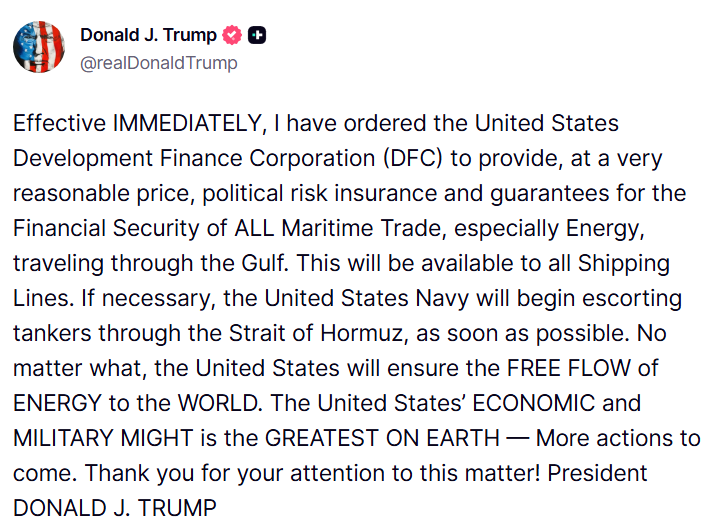
US President Donald Trump on Tuesday offered political risk insurance and a US Navy escort of tankers through the Strait of Hormuz.
The White House will offer naval escorts, political risk insurance and guarantees for the financial security of all maritime trade, especially energy, traveling through the Gulf, Trump said, in a bid to cool energy prices that have surged and give maritime shipping companies financial protection amid the war in Iran.
In a post on Truth Social, Trump ordered the United States Development Finance Corporation (DFC) to offer “at a very reasonable price, political risk insurance and guarantees for the financial security of all maritime trade, especially energy, traveling through the Gulf. This will be available to all Shipping Lines.”
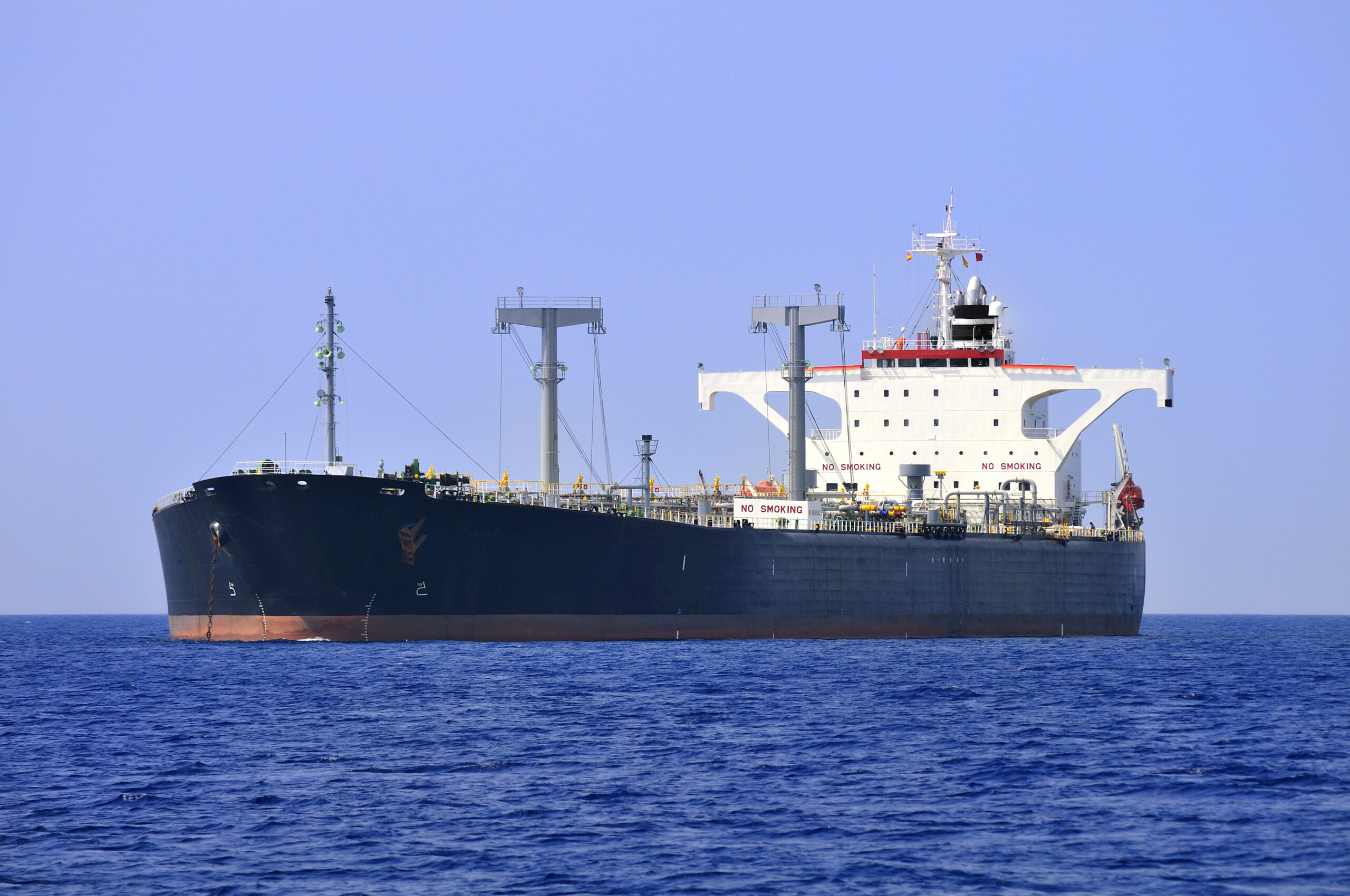
The president also said the U.S. Navy would escort tankers through the Strait of Hormuz “if necessary.”
Further details on Trump’s directive were not immediately released.
Earlier on Monday, US secretary of state Marco Rubio stressed that the U.S. would take action to mitigate rising energy prices due to a spike in the price of oil caused by the conflict with Iran.
Rubio went on to highlight that Iran had the ability potentially to shut off 20 percent of global energy. “That’s the kind of leverage they have because of their navy. We’re going to destroy their navy. But there is a plan in place,” he said.
Energy analysts warn that even the perception of instability in the Strait of Hormuz can trigger sharp price swings.
Amid surging oil prices and mounting unease across global markets, the United States has unveiled a strategy to steady energy flows and safeguard vital maritime corridors.
Energy secretary Chris Wright and treasury secretary Scott Bessent will carry out the program, Rubio told reporters on Monday.
Rubio did not divulge what it would be.
“We knew that going in would be a factor,” Rubio said of rising oil prices. “And so, we have a program in place that will begin to be implemented by Secretary Wright, Secretary Bessent. We talked about it last night, again, about this program. We talked this morning. And starting tomorrow you will see us rolling out those phases to try to mitigate against that. Obviously, markets are going to be reacting to news about what’s happening.”
He added that energy secretary Wright and treasury secretary Bessent would begin rolling out measures to cushion the economic shock and mitigate potential fallout.
“There is a plan in place. We anticipated this could be an issue. And Secretary Wright and Bessent will begin to roll out those steps starting tomorrow to mitigate – to mitigate – against the impact that could have,” Rubio told reporters.
At the heart of global anxiety lies the Strait of Hormuz, the narrow maritime artery through which a substantial share of the world’s oil and liquefied natural gas flows.
Any disruption there sends immediate tremors through international markets – with large energy importers acutely vulnerable to price shocks.
Speaking to reporters, Rubio acknowledged that markets were rattled by the escalating conflict but insisted Washington had anticipated the turbulence.
Amid ongoing debate over the purpose and effectiveness of the Iran operation, Rubio sought to clarify the administration’s reasoning during a briefing with reporters on Monday.
“The United States is conducting an operation to eliminate the threat of Iran’s short-range ballistic missiles and the threat posed by their navy, particularly to naval assets. That is what it is focused on doing right now and it’s doing quite successfully,” the secretary of state said while he was outlining the mission’s objective.
Rubio went on to highlight that right now the focus is on the destruction of Iran’s ballistic missile launchers, ballistic missile stockpiles, and ballistic missile manufacturing capability, as well as on Iran’s one-way attack drones and navy because – as he said – of the threat it poses to global shipping.
Iran’s attacks against vessels in and near the strait has become a major impediment to global crude flows, with oil tankers either waiting for clear passage or taking a much longer route to reach their destinations.
Several marine insurers have revealed they will cancel war risk coverage for ships operating in Iran and Persian/Arabian Gulf, while several shipping companies are reportedly reviewing risk assessments.
Container shipping giant CMA CGM announced an immediate suspension – until further notice – of all bookings for certain ports of loading / ports of discharging in the Middle East.
The affected Middle East countries include: Bahrain (all ports), Kuwait (all ports), Qatar (all ports), United Arab Emirates (all ports except Fujairah and Khor Fakkan), Saudi Arabia (all ports except Jeddah, King Abdallah Port, Yanbu, NEOM) and Iraq (port of Umm Qasr).
The measure aims to safeguard the company’s crew, vessels, and cargo of its customers under the current circumstances.
In another update on Tuesday, CMA CGM said emergency measures are being implemented for all shipments to and from the following countries: Iraq (Port of Umm Qasr), Bahrain, Kuwait, Yemen, Qatar, Oman, the United Arab Emirates, the Kingdom of Saudi Arabia. These measures include, but are not limited to, vessel deviations to contingency ports.
With immediate effect, Ocean Network Express (ONE) also temporarily suspended acceptance of new bookings for cargo moving both to and from the Persian Gulf until further notice.
As of March 2, 2026, tanker traffic through the Strait of Hormuz has collapsed following vessel strikes and escalating military activity in the Gulf.
While Operation Epic Fury began on February 28, the past hours reflect the operational consequences: suspended transits, halted tanker movement, insurance withdrawal, and precautionary vessel positioning across the Gulf of Oman.
While the maritime corridor remains technically open, commercial tanker passage has effectively ceased.
Maritime AI™ company Windward data shows: No active tanker transits in the primary Hormuz shipping lanes as of March 1, only one small tanker (12,000-dwt) and one small cargo vessel were observed transiting early March 2 UTC, approximately 26 tankers are drifting or berthed in the Gulf without confirmed destinations, hundreds of other vessels are holding position in the Gulf of Oman, no U.S., UK, or EU-flagged vessels were observed transiting during the March 1-2 period.
"No matter what, the United States will ensure the FREE FLOW of ENERGY to the WORLD. The United States’ ECONOMIC and MILITARY MIGHT is the GREATEST ON EARTH — More actions to come." – President Donald J. Trump
— The White House (@WhiteHouse) March 3, 2026