The United States, Britain and Australia say they will develop systems for uncrewed undersea vehicles to protect vital national seabed infrastructure and boost defence. The announcement was made by the countries’ defence ministers at a meeting in Singapore.
UK’s defence secretary John Healey said that sensors and weapons systems would be developed for the undersea drones, which would “give the ability to detect, deter, and to deal with threats including underwater cables and pipelines.”
While the project’s total cost was not stated, Healey said his nation would contribute £150m.
A joint statement said the new project would enable partners to work together to protect critical national seabed infrastructure, deploy cutting-edge surveillance, reconnaissance and strike capabilities, conduct logistics operations and bolster superiority in anti-submarine and anti-surface warfare, mine countermeasures, electronic warfare and contested littoral manoeuvre.
The joint development of transformational tech is the first signature project to be announced under AUKUS’s so-called Pillar 2 of the partnership.
With delivery starting in 2027, this project focuses on the advanced technologies carried by the UUVs, and how they work effectively with the AUKUS partners.
Under AUKUS, Pillar 1 focuses on Australia’s acquisition of conventionally armed, nuclear-powered submarines, while Pillar 2 pools the talents of each nations’ defence sector to develop advanced military capabilities to support security around the world.
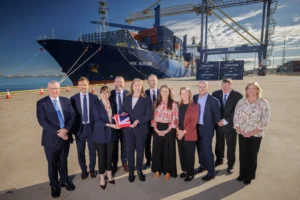
Healey announced the project alongside his US counterpart Pete Hegseth and Australian deputy prime minister and defence minister Richard Marles.
Vast amounts of global data and communications flow through undersea cables, making them essential to daily life in the U.S. and its allies.
Incidents involving damaged cables in regions including the Baltic Sea and waters around Taiwan have sharpened those concerns.
“It is striking that several cables have been severed across the Baltic and the Taiwan Strait since November 2024. Now, maybe these were accidents. But even if they were, it highlights the vulnerability of this crucial part of the globe’s infrastructure. If they were intentional, we are left to wonder: are countries testing our response times, testing our attribution thresholds and testing our political will to respond?” said Richard Marles.
Around ninety-nine percent of Australia’s internet traffic flows through just fifteen subsea cables.