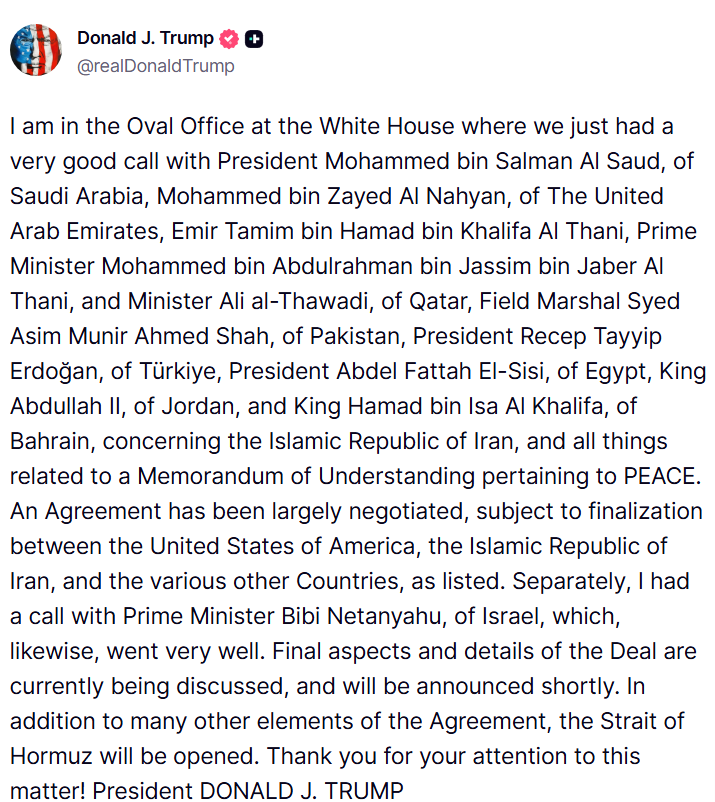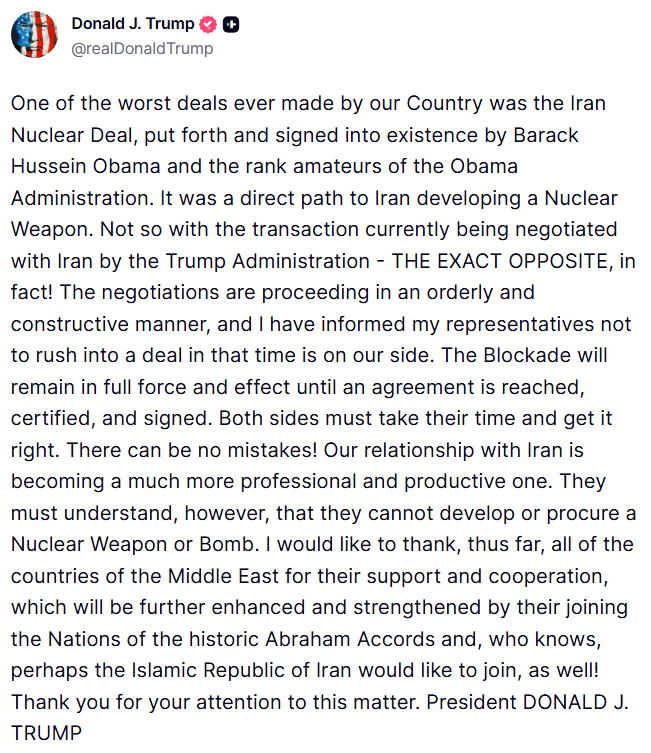
US secretary of state Marco Rubio warned Friday that Iran is trying to create a “tolling system” for commercial shipping to pass through the Strait of Hormuz, urging for the development of a contingency “Plan B” to ensure the reopening of the Strait of Hormuz if Iran continues to refuse cooperation. The announcement came one day before US president Donald Trump said he spoke with leaders from Saudi Arabia, the United Arab Emirates, Qatar, Egypt, Jordan, Bahrain, Pakistan and Türkiye concerning Iran and a potential “memorandum of understanding pertaining to peace.” Details of the deal will be announced “shortly” – but the US president confirmed that the Strait of Hormuz will be opened. Trump said on Saturday that a deal with Iran was “largely negotiated” … “subject to finalization between the United States of America, the Islamic Republic of Iran, and the various other countries” and would include the reopening of the Strait of Hormuz following a phone call with Arab allies in the region. Trump also referenced a conversation with Israeli prime minister Benjamin Netanyahu, which he said, “went very well.” However, he clarified on Sunday that the blockade on Iranian ports would remain in full force and effect until an agreement is reached, certified, and signed.
Speaking in Helsingborg, Sweden, during a NATO foreign ministers meeting, Rubio accused Tehran of attempting to create a “tolling system” that could upend global shipping lanes and embolden other nations to follow suit.
“Iran is trying to create a tolling system. They’re trying to convince Oman, by the way, to join them in this tolling system in an international waterway,” Rubio said.
Rubio noted that Iran appears to be the only government supporting the scheme. “There is not a country in the world that should accept that.”
The Secretary of State emphasized that allowing the tolling system would set a disastrous global precedent. “I don’t know of a country in the world that’s in favor of it except Iran,” he continued.
Western politicians say Iranian proposals for the future permanent management of the strait are unlawful and set a precedent for other similar waterways.
The Secretary of State warned that surrendering control of the Strait of Hormuz could spark similar attempts elsewhere. He argued that if the international community tolerates such a move in Hormuz, other nations could attempt similar actions.
“That’s just not acceptable. It can’t happen. If that were to happen in the Strait of Hormuz, it will happen in five other places around the world.”
Rubio also stressed the waterway is vital not just to NATO allies but to countries across the Indo-Pacific and beyond.
“Why would countries all over the world say, well, we want to do this too, not to mention how vital and critical that strait is to every country represented here today, but frankly to countries not represented here today, particularly the Indo-Pacific,” he said.
Rubio has also urged the development of a contingency “Plan B” to ensure the reopening of the Strait of Hormuz if Iran continues to refuse cooperation on international shipping access.
Addressing journalists at the ministerial summit in Helsingborg, he emphasised the necessity of operational readiness, remarking, “We have to start thinking about what do we do if a few weeks from now Iran decides we don’t care, we’re going to keep the straits closed, we’re going to sink any ship that doesn’t listen to us or doesn’t pay us.”
In this scenario, “then someone is going to have to do something about it…. The United States could do it. But there are countries that have expressed an interest in potentially being a part of something like that if, in fact, we get to that point. We don’t need their help, but they’re willing to do it, and I think we should take them up on it if they are. But I don’t think there’s been any firm commitments or firm asks today; it would be premature,” he argued. “I know there’s a plan in place for what to do if the shooting stops. It’s what the French-UK initiative talks about, when the conditions are set.”
Trump vows Hormuz will reopen as Iran peace deal “largely negotiated”
Donald Trump said that a deal with Iran, including reopening the Strait of Hormuz, has been “largely negotiated.”
The US president posted the announcement on Truth Social on Saturday, saying he had held calls with Israel and other allies in the region.
Trump said final aspects and details of the deal are being discussed and will be announced “shortly” but was not more specific about the timetable for a further announcement.
He said he had spoken with President Mohammed bin Salman Al Saud, of Saudi Arabia, Mohammed bin Zayed Al Nahyan, of The United Arab Emirates, Emir Tamim bin Hamad bin Khalifa Al Thani, Prime Minister Mohammed bin Abdulrahman bin Jassim bin Jaber Al Thani, and Minister Ali al-Thawadi, of Qatar, Field Marshal Syed Asim Munir Ahmed Shah, of Pakistan, President Recep Tayyip Erdoğan, of Türkiye, President Abdel Fattah El-Sisi, of Egypt, King Abdullah II, of Jordan, and King Hamad bin Isa Al Khalifa, of Bahrain, along with Israel.
Trump said the deal was “subject to finalization between the United States of America, the Islamic Republic of Iran, and the various other countries.”
NATO foreign ministers discuss about Hormuz in Sweden
NATO foreign ministers concluded a meeting in Helsingborg, Sweden, on May 22. Their discussions helped lay the groundwork for the upcoming NATO summit in Ankara this July.
A stronger and fairer NATO, increased defence spending, stronger defence industrial production, and continued support to Ukraine were among the key topics discussed in Helsingborg, NATO secretary general Mark Rutte said following the meeting.
NATO foreign ministers also discussed wider developments affecting allied security, including the situation in the Middle East. By closing the Strait of Hormuz, Iran threatens freedom of navigation and global commerce and “attempts to hold the global economy hostage,” Rutte said. “This is another clear reminder of how security challenges are increasingly interconnected – and that Allies and partners have a strong interest in working closely and proactively together,” he added.
France and the United Kingdom have begun efforts to build a military coalition that can help ensure safe maritime traffic through the strait, but have been clear that such operations will only begin once the conflict with Iran is over.
IMO urges member states to assist trapped seafarers
The IMO Maritime Safety Committee (MSC) adopted recently a resolution requesting the support of its member states for the secretary-general’s (Arsenio Dominguez) ongoing efforts to facilitate the safe evacuation of ships and seafarers trapped in the Persian Gulf. Around 20,000 seafarers, as well as port workers and offshore crews, are impacted in the region.
The Committee urged member states and organizations to assist trapped seafarers by providing essential supplies, establishing helplines and remote support, and keeping families informed. Crew changes were also encouraged.
The 111th session of the Maritime Safety Committee was held on May 13-22, 2026, in London.
The Committee requested the secretary-general to closely monitor the situation and provide regular updates to member states and relevant IMO bodies.
U.S. says its blockade against Iran has redirected 100 ships
U.S. Central Command (CENTCOM) forces have redirected 100 commercial vessels, while enforcing a maritime blockade against Iran.
American forces began implementing the blockade on April 13 against commercial ships entering and exiting Iranian ports, in accordance with a presidential proclamation.
Over the past six weeks, more than 15,000 soldiers, sailors, marines and airmen have redirected 100 vessels, disabled four, and allowed 26 humanitarian aid ships to pass.
More than U.S. 200 aircraft and warships are supporting the mission, including the Abraham Lincoln Carrier Strike Group, George H.W. Bush Carrier Strike Group, Tripoli Amphibious Ready Group/31st Marine Expeditionary Unit, and multiple guided-missile destroyers.
The blockade is being enforced against vessels of all nations entering or departing Iranian ports and coastal areas, including all Iranian ports on the Arabian Gulf and Gulf of Oman.