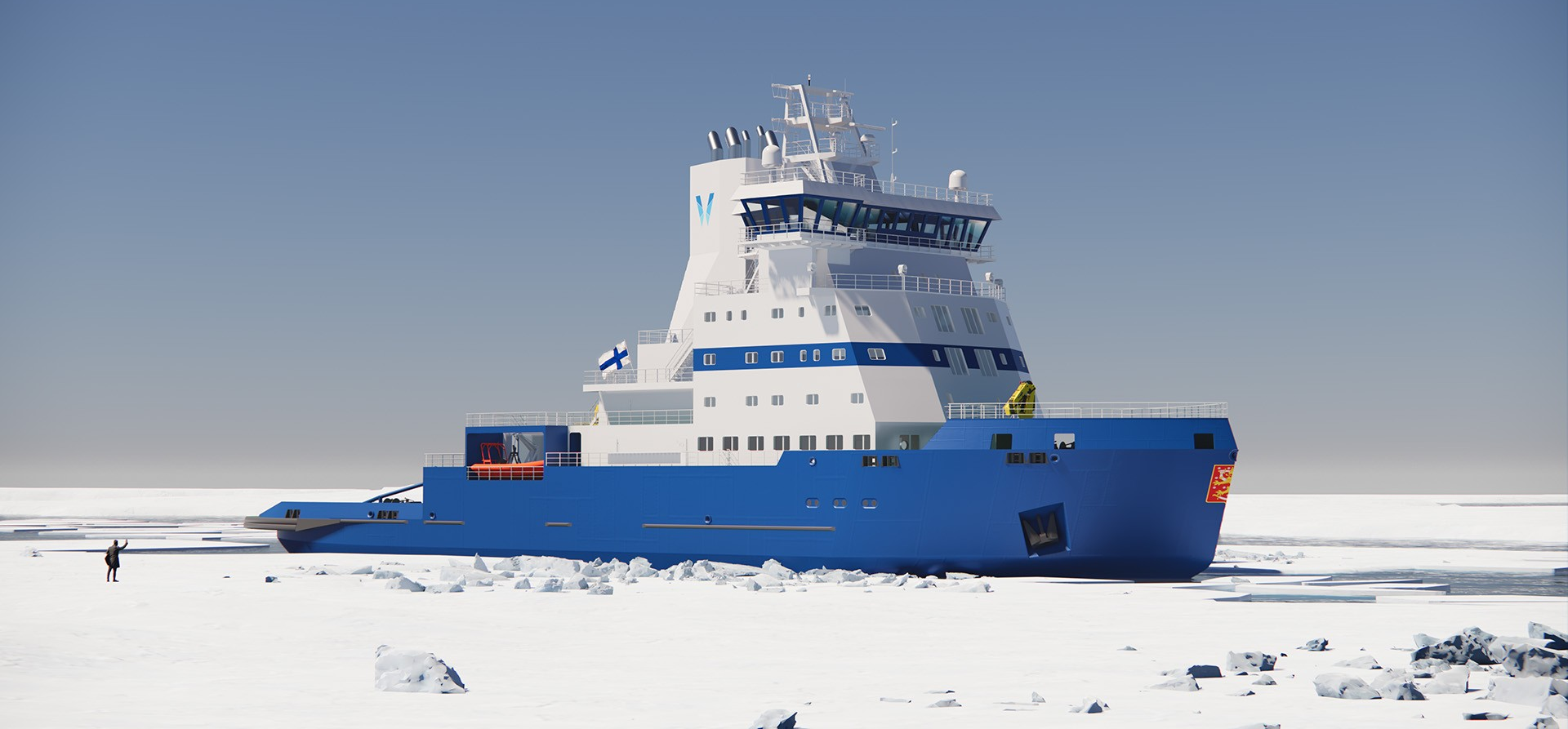
Finland is making progress on a project to replace the 70-year-old Voima with a new icebreaker. They announced the progress, reporting that the concept design for the new icebreaker commissioned by the Finnish Transport Infrastructure Agency is now complete.
In the final stages, the focus was on the choice of propulsion solution for the vessel. The solution has been considered as a whole, focusing on reliable performance, cost-effectiveness and the vessel’s ability to operate in the typical ice- and open water conditions of the Bothnian Sea and the Gulf of Finland now and in the future.
The new icebreaker will replace the old Voima. At around 96 metres long and with 10.5 megawatts of engine power, the icebreaker will have the same power as the Voima, but will be much wider: the new vessel will be 24 metres wide, compared to the Voima’s 19 metres.
The increased beam and the modern hull and propulsion solution will significantly improve the vessel’s open water characteristics and performance in icy conditions.
The new icebreaker is designed for better seaworthiness in open water which it will encounter more frequently in the coming decades due to climate change.
The next step is to invite tenders from shipyards for the project. The construction is scheduled to start in 2027.
The construction of the icebreaker is part of the WINMOS IV project, which has received €42m in CEF funding. It should be ready in September 2029.
“As the contractor, the Finnish Transport Infrastructure Agency has always had a very clear understanding of what kind of icebreaker is needed to replace the 70-year-old Voima,” said Helena Orädd, head of the maritime transport unit.
The aim is for the new icebreaker’s life cycle to exceed 50 years. The ice winters of the future at sea will continue to be challenging, and possibly even more challenging than today, as the wind will press ice masses together and the conditions in the ice field will vary.
The B+ icebreaker is intended to be among the first icebreakers to start operating in the Bothnian Bay and to move to the Bothnian Sea and Gulf of Finland in harsher winters if necessary.