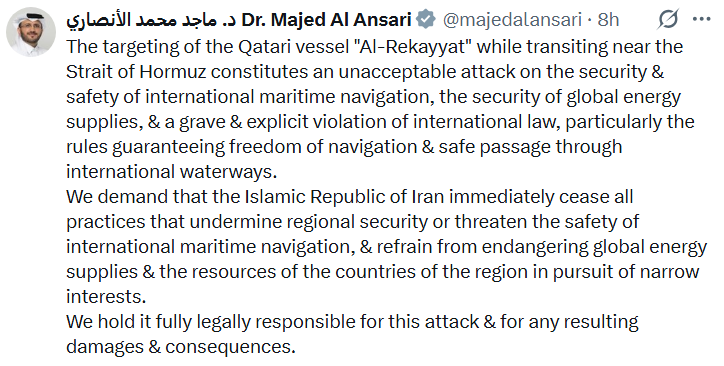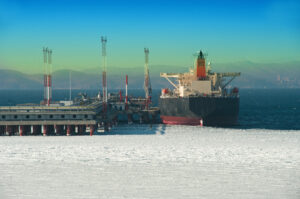
Qatar blamed Iran for the attack on the LNG carrier Al Rekayyat while transiting near the Strait of Hormuz.
Qatar’s foreign ministry spokesperson, Majed Al Ansari, said on Tuesday the targeting of the Qatari vessel Al Rekayyat near the Strait of Hormuz was an unacceptable attack on the security of international navigation and global energy supplies.
Describing the incident as a clear violation of international law, he urged Iran to immediately halt actions threatening regional security and maritime navigation, and said Tehran bore full legal responsibility for the attack and any resulting damage and consequences.
“We demand that the Islamic Republic of Iran immediately cease all practices that undermine regional security or threaten the safety of international maritime navigation, and refrain from endangering global energy supplies and the resources of the countries of the region in pursuit of narrow interests. We hold it fully legally responsible for this attack and for any resulting damages and consequences,” the spokesman posted on X.
There was no immediate comment from Tehran, or any claim of responsibility.
Earlier, UKMTO said a tanker traveling southbound was struck by an unknown projectile on its port side, causing a fire, approximately 8 nautical miles east of Limah, Oman.
The United Kingdom Maritime Trade Operations (UKMTO) issued warning 080-26 on Monday evening based on a report from the vessel’s master.
The UK Maritime Trade Operations center (UKMTO) said late Monday local time that it received a report of a tanker being struck by an unknown projectile about 8 nautical miles east of Limah, Oman.
UKMTO didn’t disclose the name of the vessel or the company.
The projectile hit the vessel on its port side, causing a fire while the ship was travelling southbound.
UKMTO said no casualties or environmental damage had been reported. Authorities are investigating the incident. Vessels in the area are advised to transit with caution and to report any suspicious activity to UKMTO.
The incident and advisory occur amid a pattern of maritime security challenges in the Strait of Hormuz, including prior attacks on commercial vessels.
The reports underscored the persistent risks to shipping around the Strait of Hormuz despite the safe passage provisions included in an interim agreement between Washington and Tehran.
Indirect U.S.-Iran talks ended last week without any public sign of headway toward a lasting peace, despite a 60-day ceasefire intended to create space for diplomacy to end the conflict.
Commercial vessels have come under attack during the war that began with U.S.-Israeli strikes on Iran, despite an interim agreement that included safe-passage provisions.
The attack came as US president Donald Trump headed to a NATO leaders’ summit in Ankara, Türkiye. The 2026 Ankara Summit is the second NATO summit hosted by Türkiye.
The US war with Iran is expected to be a major topic of discussion, with Trump having expressed anger at several members of the North Atlantic Treaty Organization for not doing more to help the US against Iran.
Iran rejects Qatar’s allegation over incident involving Qatar-linked vessel in Hormuz
Iran rejected on Wednesday Qatar’s allegation over reported incident involving Qatar-linked vessel in Strait of Hormuz.
Iranian foreign ministry spokesperson Esmail Baghaei expressed regret over the Qatari Foreign Ministry’s accusation against Iran regarding the alleged attack on a Qatar-linked vessel in the Strait of Hormuz on Tuesday July 7 describing the allegation as questionable contrary to the principle of good neighborliness and unacceptable.
Referring to clause 5 of the Memorandum of Understanding on the Termination of the War, dated June 18, 2026, which commits the Islamic Republic of Iran to taking the necessary measures for the future administration of the Strait of Hormuz and the provision of maritime services, the foreign ministry spokesperson stressed that Iran is seriously implementing its commitments.
He added that Iran expects regional countries – particularly Qatar, which, in its role as mediator, is fully aware of the details of the Memorandum of Understanding – as well as shipping companies, to refrain from any actions that would be inconsistent with the provisions of the agreement.
The foreign ministry spokesperson also referred to the conduct of certain commercial vessels that have been navigating through routes not coordinated with Iran while switching off or manipulating their ship tracking or Automatic Identification System (AIS) signals in order to conceal their movements from monitoring and maritime safety systems. He noted that such practices increase the risk of collisions, create environmental hazards, undermine the security of the shipping route, and disrupt the Islamic Republic of Iran’s efforts to facilitate safe navigation through the Strait of Hormuz.
Tehran Rejects Western Architecture
Earlier on July 2, Iran criticised a US-led regional security summit held in Bahrain. Tehran rejected what it described as Western attempts to shape the security architecture of the Persian Gulf and the Strait of Hormuz.
In a post on X, Iran’s deputy foreign minister for legal and international affairs Kazem Gharibabadi argued that the US military command had no authority over the waterway. “Hormuz is defined under Iran’s command, not CENTCOM,” he said.
He maintained that the military summit in Bahrain could not establish “legal order and security for the Persian Gulf.”
Gharibabadi said the region’s security will be ensured through the end of interventions and the U.S. withdrawal from the area, respect for countries’ sovereignty, and acceptance of “new geopolitical realities” and “not under the military umbrella of America.”