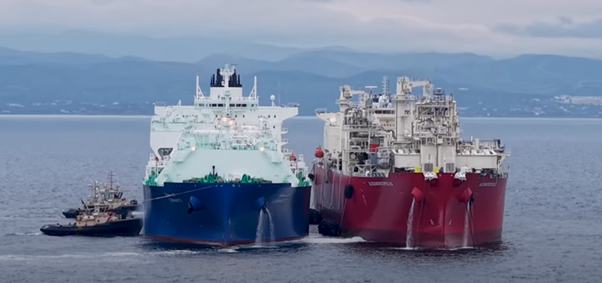
The first US-origin cargo of liquified natural gas (LNG) arrived at the Alexandroupolis FSRU terminal in northeast Greece, destined to supply the Bulgarian market.
Athens-based industrial and energy company Metlen, (previously known as Mytilineos), said the shipment confirms its role as a key pillar of energy security in Southeastern Europe.
Metlen Energy Supply & Trading chief executive director Panagiotis Kanellopoulos hailed the arrival of the first US-origin LNG cargo in a video published by the company.
The company’s collaboration with the Bulgarian state-owned company Bulgargaz began in 2018, when gas flows from Greece to Bulgaria were first executed on behalf of Bulgargaz, opening a new energy corridor in Southeastern Europe.
Since then, Metlen has become a strategic supplier of LNG, natural gas, and integrated energy services to the Bulgarian market.
“Since 2010, we have consistently supplied the Greek market and, in 2018, became the first company to import LNG via Revythoussa and export it to Bulgaria,” Kanellopoulos said in a statement released Monday. “Over the years, we have demonstrated Greece’s role as a real energy hub, as well as METLEN’s pivotal role in delivering reliable and competitive LNG throughout the Balkans and beyond. Today, with the introduction of this U.S.-sourced cargo for the Bulgarian market, our long-standing partnership with Bulgargaz grows even stronger, as we continue contributing to regional energy security with reliability.”
The arrival comes just weeks after Greece, Bulgaria and Romania signed a memorandum of understanding in Brussels to accelerate the development of the transport axis connecting the Aegean Sea with the Black Sea.
The initiative is under the aegis of the European Commissioner for Sustainable Transport and Tourism Apostolos Tzitzikostas, who signed a European Commission Declaration in support of it.
“The Black Sea-Aegean Sea region is no longer Europe’s periphery. This is where two of Europe’s great corridors meet: the Baltic Sea – Black Sea – Aegean Sea corridor of the TEN-T, and the Rhine-Danube corridor. This intersection gives Greece, Bulgaria and Romania a unique responsibility. You are the gatekeepers of strategic economic arteries, of vital supply chains, and of our Union’s military mobility routes,” said Commissioner Tzitzikostas, emphasising in his speech the crucial role of the corridor in the European transport network.
The Commissioner underlined that this link, from Thessaloniki to Alexandroupoli and to Bucharest through Bulgaria, and onward to Moldova and Ukraine will become one of Europe’s most important strategic and secure arteries.
In his statement, Bulgarian deputy prime minister Grozdan Karadzhov referred to the importance of the project. As Mr Karadzhov noted, “for decades, the notion of true connectivity between the North and South remained only on paper – without real action. Today we are beginning to change that because the commitment we are making is not a symbolic gesture, but a real step towards opening new arteries for trade and creating the resilience necessary for Europe.”