Global container vessel schedule reliability remains somewhat stable around 60‑65%, showing no signs of improvement, and in stark contrast to the 2011‑2019 normality of 70‑80%, Denmark-based research and analysis specialist Sea‑Intelligence reported.
Furthermore, late vessel arrivals are now settling into 5‑5.5 days of delay, up from the pre-pandemic norm of 3‑4 days. This structural shift to a larger risk of vessel delays, and their longer durations, inexorably leads to a larger share of global capacity being rendered unavailable, as vessels stuck in delays do not move cargo.
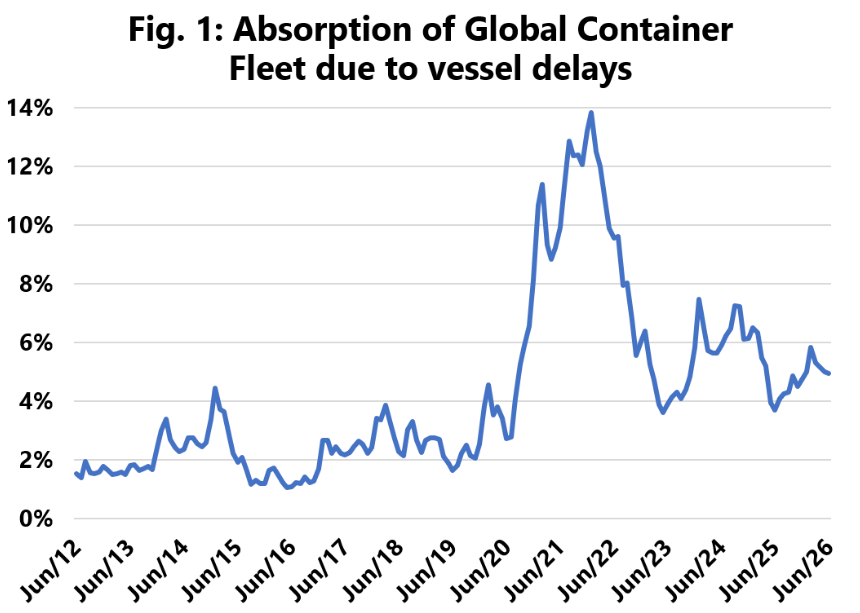
The share of these delayed vessels combined with the duration of the delays, can be used to calculate the amount of global deep‑sea capacity effectively absorbed by delays (figure 1).
In accordance with Sea‑Intelligence report, the container shipping industry was quite stable in 2011‑2019.
During that time, on average, only 2.2% of the world’s container shipping capacity was tied up by delays.
The industry accepted this 2.2% rate as a standard part of balancing supply and demand.
“However, following the pandemic, things have changed a lot,” the research and analysis specialist said on August 19.
Now, a total of 5.0% of all global deep‑sea capacity is tied up. This means that 2.8% more shipping space is absorbed right now, compared to what was considered to be normal pre-pandemic.
“We can use the current global fleet size to calculate how much total cargo space is currently unusable due to vessel delays. Right now, with a 5% absorption rate, the global market is “missing” capacity for 1.7 million TEUs from continuous delays,” Alan Murphy, chief executive officer of Sea-Intelligence noted.
Note: The full report can be found here.