The container shipping market is faced with the adverse situation of a slowdown in trade volume growth for 2027.
The IMF’s October 2026 World Economic Outlook (WEO) report predicts a decline in world trade volume growth from 5.0% in 2025 to 4.7% in 2027.
In advanced economies, import demand is projected to be 5.0% in 2026 but soften to 4.2% in 2027.
“This means that demand is not growing fast enough to absorb all the newly built vessel capacity entering service,” said Denmark’s research and analysis specialist Sea‑Intelligence.
In issue 787 of the Sea-Intelligence Sunday Spotlight, the company analysed the IMF October 2026 World Economic Outlook report, from a container shipping perspective.
Direct bilateral trade between the US and China has also contracted because of the trade war.
As shown in figure 1, after new tariffs were put in place in 2025, Chinese exports sent directly to the US fell by ‑22% over 12 months. During that same period, US exports to China dropped by ‑25%. However, overall trade volumes did not collapse, because the production went to other places.
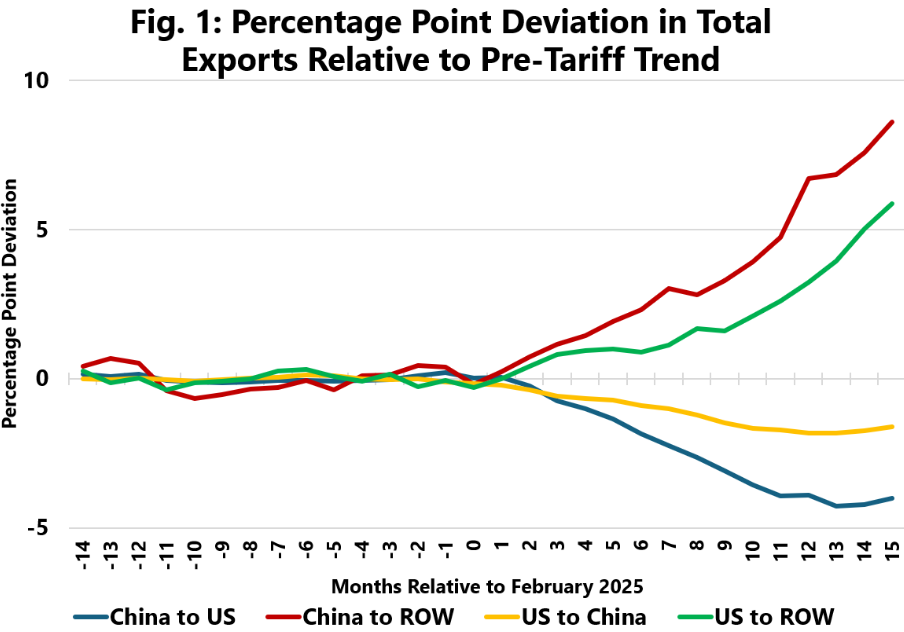
Chinese producers redirected 52% of their products to other Asian countries, and US exporters redirected 17%. Instead of shipping directly from China to the US, manufacturers are now sending parts to countries like Vietnam, Malaysia, and Indonesia.
As Sea-Intelligence explained, the products are put together there and then shipped to the US. This keeps trade volumes steady, but for the manufacturers and shippers, this makes logistics much more complicated, adds extra stops at ports, and increases costs.
According to WEO estimates, global growth is projected at 3.1% in 2026 and 3.4% in 2027, unchanged for 2026 and revised moderately upward for 2027, relative to the projections in the April 2026 World Economic Outlook.
Global headline inflation is projected to increase to 4.7% in 2026 before easing to 4.1% in 2027, marking a cumulative upward revision of 0.7 percentage point with the temporary increase driven mainly by energy and food prices.
At the same time, an artificial intelligence boom is impacting trade. Trade in AI hardware has reached record highs compared to global GDP. While the money spent on AI trade has grown a lot, the actual physical weight of these goods has barely grown. This shows that the boom is driven by high prices rather than large physical volumes. While the physical microprocessors are normally moved by air, the heavy materials needed to build AI data centres are moved in ocean containers, providing important heavy cargo for shipping lines.