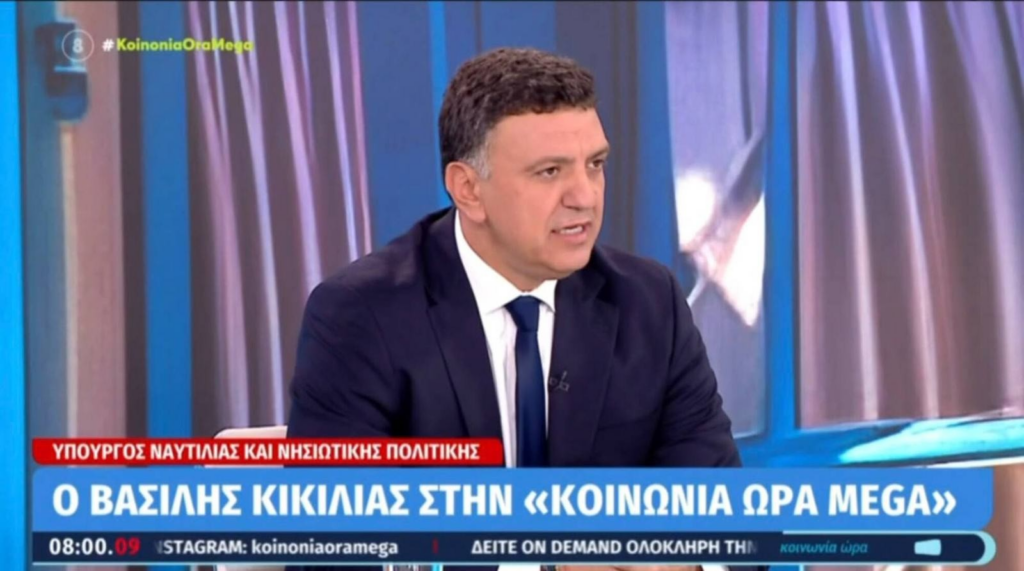
Greek minister of maritime affairs and insular policy Vasilis Kikilias highlighted the government’s efforts to keep ferry fares stable for a second consecutive year, despite pressures stemming from the war and the energy crisis, as well as the significant discounts that have emerged through increased competition, in an interview with Mega TV.
The minister stressed that “international developments and rising fuel prices have created a particularly challenging environment for the ferry sector,” adding: “Last year, the market announced fare increases of 15% because of the cost of green fuels linked to European obligations. However, we succeeded in preventing those increases from taking effect by offsetting them through our decision to reduce port fees by 50%. This year, too, the Greek government and the Maritime Ministry found a way to prevent further increases, while competition has led to targeted discounts ranging from 25% to 42% on both high-speed and conventional ferries for families, groups of three, return tickets, economy-class and cars.”
Kikilias made clear that ferry fares are determined by the market and monitored by the Competition Commission, underlining that the presence of more ferry operators can foster genuine competition that benefits travellers.
Especially for Rafina, Kikilias pointed out that “there are three ferry companies there, and the competition between them has led to discounts of up to 50% on ferry tickets.”
He described ferries as a popular means of public transport, saying he doesn’t see it as a luxury for a Greek family to be able to visit an island.
“I declare once again that we are interested in the many and we will support the many and the possibility and right that a Greek family with children, both parents, has to go to an island to see their grandparents or to take a week’s vacation. We neither consider this a luxury nor do we consider that our islands should be Ibiza or Saint Tropez or Cannes. Our islands are for everyone, they are our ornaments, they are our diamonds,” he stressed.
Concluding, the minister pledged that the government’s efforts to keep fares under control and secure further reductions through discounts would continue.
“We are fighting tooth and nail to keep ferry ticket prices from rising – and that is extremely difficult – and to reduce them through discounts,” he said.
More Than 1,800 Vessel Inspections
Kikilias said the ministry has conducted more than 1,800 surprise inspections on ferries, excursion boats, tourist vessels, yachts, and other ships to ensure compliance with safety regulations.
“There are discounts on tickets, but there are no discounts on safety,” he said. “Safety means strict inspections, and we are not willing to compromise.”
He emphasized that local port authorities have full authority to delay a vessel’s departure, prevent it from sailing, or order additional inspections if any safety concerns arise.
Kikilias also said he had instructed coast guard personnel to remain visible in the field rather than working from offices, adding that inspections will continue throughout the ferry season.
Souda Vessels Collision Under Investigation
The minister also commented on the recent collision involving two vessels – a ro-ro/passenger ship and a ro-ro cargo ship – at the port of Souda on the island of Crete, describing the incident as deeply concerning.
“We are very troubled by this accident and collision,” he said. He noted that responsibility for the incident is being investigated by a prosecutor.
Hellenic Coast Guard Recruitment Planned
The shipping minister also announced that 500 new coast guard officers are expected to be recruited through Greece’s Supreme Council for Civil Personnel Selection (ASEP) at the end of August.
He said the government also aims to recruit an additional 500 officers at the end of this year, beginning 2027, to help address significant staffing shortages within the Hellenic Coast Guard.