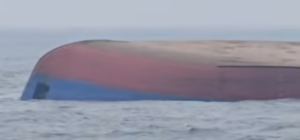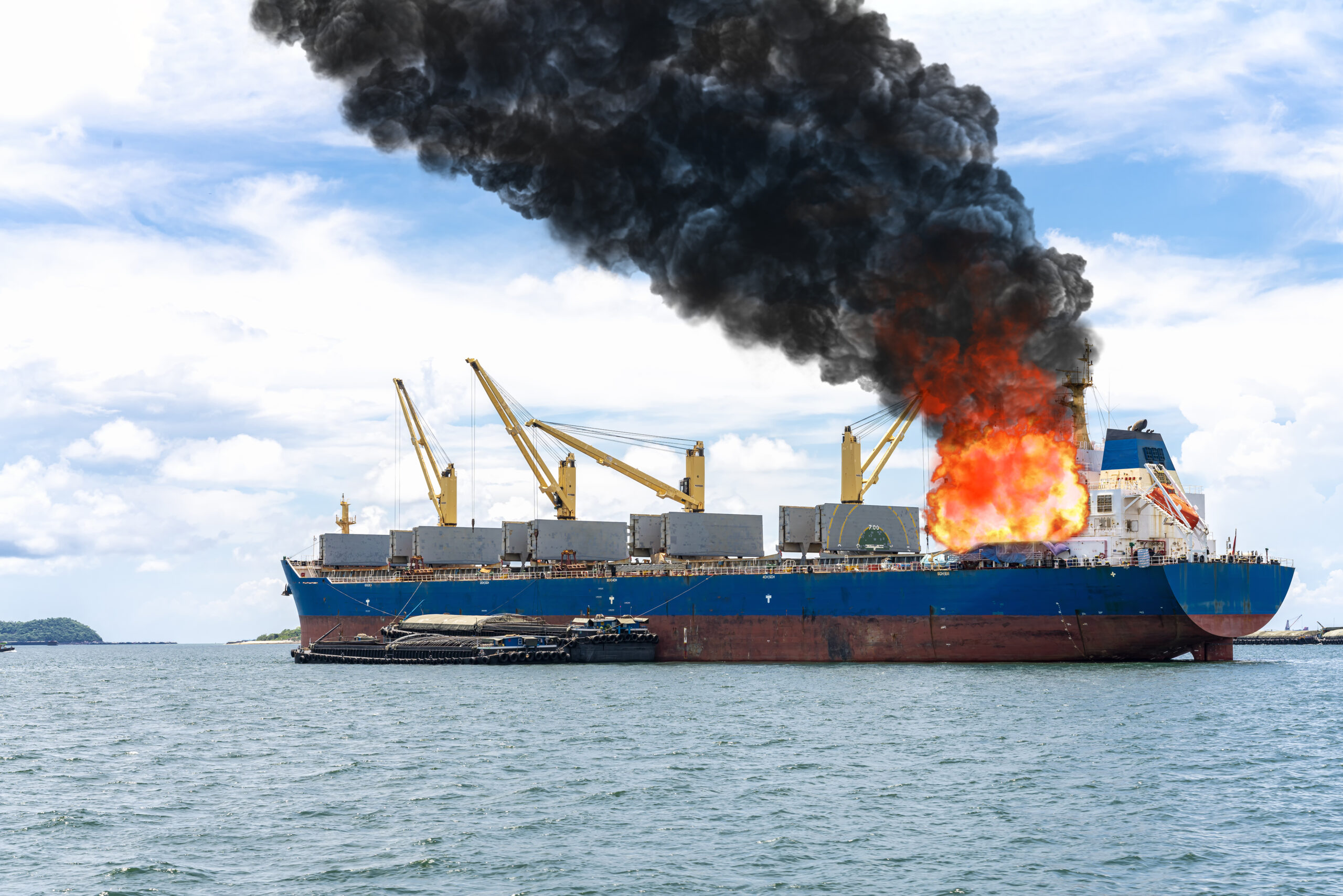
Russian forces launched a strike against a civilian cargo ship sailing under the flag of Liberia in an Odesa region port, killing one crew member and injuring three others, the Ukrainian Sea Ports Authority (USPA) reported on Saturday, Oct. 3.
According to an official statement published by the USPA, thirteen crew members were evacuated to a safe location.
The Ukrainian Sea Ports Authority framed the strike as a deliberate Russian attack on civilian shipping.
“Russia has once again attacked a civilian vessel,” the authority stated.
The attack killed a sailor aboard the commercial vessel and injured three other crew members, while 13 crew members were evacuated.
The statement comes as Black Sea security remains a major regional issue.
From grain routes and energy supplies to undersea cables, what happens in the Black Sea has direct implications for the regional security. Russia’s attacks on civilian cargo ships bound for Ukrainian ports in the Black Sea are strangling Kyiv’s vital export corridor.
Ukraine has also increased attacks on Russian shipping in the Sea of Azov and on Moscow’s so-called shadow fleet of oil tankers used, as it claims, to evade Western sanctions.
Russia open to Black Sea security talks: Kremlin
Russia is open to dialogue with all countries on ensuring security in the Black Sea, but currently is not engaged in any talks on bilateral agreements. This was stated by Dmitry Peskov, press secretary of Russian president Vladimir Putin, quoted by TASS news agency.
This was his response to a question about whether bilateral agreements with other countries, including India, Egypt and Turkey, are being considered.
“It depends [on bilateral agreements], we are open to dialogue with all countries but are not engaged here in any concrete talks,” Peskov said.
When asked whether Russia has any proposals on Black Sea security from other countries, he replied that this topic was raised at a Valdai Club meeting on October 1 and “the president gave the answer.”
Ukrainian president Volodymyr Zelenskyy met recently with his Turkish counterpart Recep Tayyip Erdoğan and discussed security in the Black Sea and how to ensure the operation of the maritime export corridor.
“In fact, there are countries on every continent that depend on our food exports,” Zelenskyy stressed. “And there are now various options on the table for how the corridor can be fully restored. What is needed is simply Russia’s readiness to stop its terrorist strikes on our infrastructure, so that Ukraine can reciprocally halt its long-range responses.”
Estonia bans transit of Russian, Belarusian grain through its territory
Estonia recently banned the transit of Russian and Belarusian grain through its territory. The decision was made against the backdrop of Russia’s war against Ukraine and attacks on Ukrainian ports.
As Estonia’s foreign minister Margus Tsahkna stated, Russia is attacking Ukrainian ports, blocking the export of Ukrainian grain, and seeking new routes to transport its own grain, but Estonia will not provide such a route.
“Russia attacks Ukrainian ports, blocks Ukraine’s grain exports and then looks for new routes for its own grain. Estonia will not provide one,” Tsahkna wrote in a post on X.
He added that the Baltic countries are working together to ensure that their ports do not become a transit route for Russia.
“I warned already in September: do not make plans to transport Russian grain through Estonia,” he said. “Today, we turned that warning into law. Together with Latvia and Lithuania, we are working to ensure that Baltic ports do not become a transit route for Russia.”