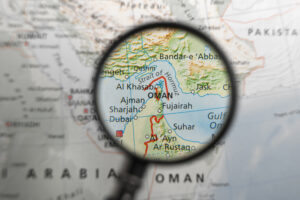
The U.S. military launched a series of strikes against Iranian targets early on Wednesday, following attacks on three commercial ships in the Strait of Hormuz.
U.S. Central Command (CENTCOM) confirmed the actions in a social media statement, asserting that American forces initiated the strikes “to impose heavy costs for targeting and attacking commercial shipping crewed by innocent civilians in an international waterway.”
The statement further condemned Iran’s actions, describing them as “unwarranted, dangerous, and a clear violation of the ceasefire.”
It added: “The U.S. strikes are in response to Iranian attacks on three commercial vessels that were transiting the Strait of Hormuz.”
Qatar blamed Iran for the attack on the LNG carrier Al Rekayyat while transiting near the Strait of Hormuz.
Qatar’s foreign ministry spokesperson, Majed Al Ansari, said on Tuesday the targeting of the Qatari vessel Al Rekayyat near the Strait of Hormuz was an unacceptable attack on the security of international navigation and global energy supplies.
In response, Iran rejected on Wednesday Qatar’s allegation over the reported incident involving the Qatar-linked vessel in the Strait of Hormuz.
Iranian foreign ministry spokesperson Esmail Baghaei expressed regret over the Qatari foreign ministry’s accusation against Iran regarding the alleged attack on a Qatar-linked vessel in the Strait of Hormuz on Tuesday July 7 describing the allegation as questionable contrary to the principle of good neighborliness and unacceptable.
In a potentially major blow to the ceasefire agreement the U.S. and Iran struck last month, pausing the conflict that started in February with U.S. and Israeli strikes against Iran, Washington moved on Tuesday to withdraw a key concession that had allowed Iran to sell oil on international markets.
The US Treasury Department had initially agreed to lift sanctions on the sale of Iranian-origin crude oil, petroleum and petrochemical products for 60 days through August 21 as part of the ceasefire agreement.
The pact allowed traffic through the Strait of Hormuz to increase, contributing to a decline in global oil prices.
A notice published Tuesday by the US Treasury Department said only that its earlier temporary sanctions relief had been “revoked and superseded in its entirety.”
In revoking that license on Tuesday, it gave Iran until July 17 to wind down any transactions in progress.
Trump is meanwhile at a high-stakes Nato summit in Ankara, Türkiye, after he insisted on loyalty after some Nato countries balked at allowing US forces to use their bases for attacks on Iran.
The latest tensions follow Trump’s criticism of NATO allies, including Italian prime minister Giorgia Meloni, over Italy’s refusal to support US military efforts against Iran. In a Truth Social post last month, Trump accused some allies of failing to back the US.
The disagreement marked a sharp shift in relations between the two leaders, who had previously maintained cordial ties.
Despite the recent war of words, Italy remains a key US ally within NATO.
Iran warns any military adventurism in Hormuz will have consequences
Iran has objected to British and French military help aimed at protecting shipping in the Strait of Hormuz. The passage should be secured by coastal states rather than outside powers, Tehran insists.
Iran’s deputy foreign minister for legal and international affairs Kazem Gharibabadi has warned that any military adventurism in the Strait of Hormuz will have consequences, saying that the responsibility of ensuring the security of the waterway lies with its coastal states.
“The Strait of Hormuz is not a theater for the military display of extra-regional powers,” Gharibabadi wrote on his X social media account on Saturday, reacting to a joint statement by France and Britain on the Strait of Hormuz.
“Iran, as the responsible power and guarantor of the Strait’s security, warns with sensitivity to any military movement in this waterway,” he said.
Gharibabadi emphasized that “the security of Hormuz lies with the coastal states,” adding, “crisis-makers will be held accountable for the consequences of their adventurism; this is a serious warning.”
Iran rejects Germany’s Strait of Hormuz mining allegations
Iranian foreign ministry spokesperson Esmaeil Baqaei on Tuesday sharply criticised Germany over remarks by German foreign minister Johann Wadephul on the Strait of Hormuz, accusing Berlin of complicity in military aggression against Iran.
In a post shared on X, Baqaei alleged that Germany bore responsibility for supporting actions against Iran.
He further posted on his social media account X an article under the headline: “Germany says Iran should pay for mine clearance in Strait of Hormuz.”
The UK’s Prime Minister’s office released a joint statement on Friday by Keir Starmer and French President Emmanuel Macron, in which the two leaders described the Strait of Hormuz as a “vital artery for the global economy”.
The statement claimed that Oman has agreed to cooperate with Britain and France to ensure that its sovereign territorial waters are safe for navigation.
London and Paris also announced their readiness to deploy what they called a “broader multinational military mission” to support freedom of navigation in the Strait of Hormuz.