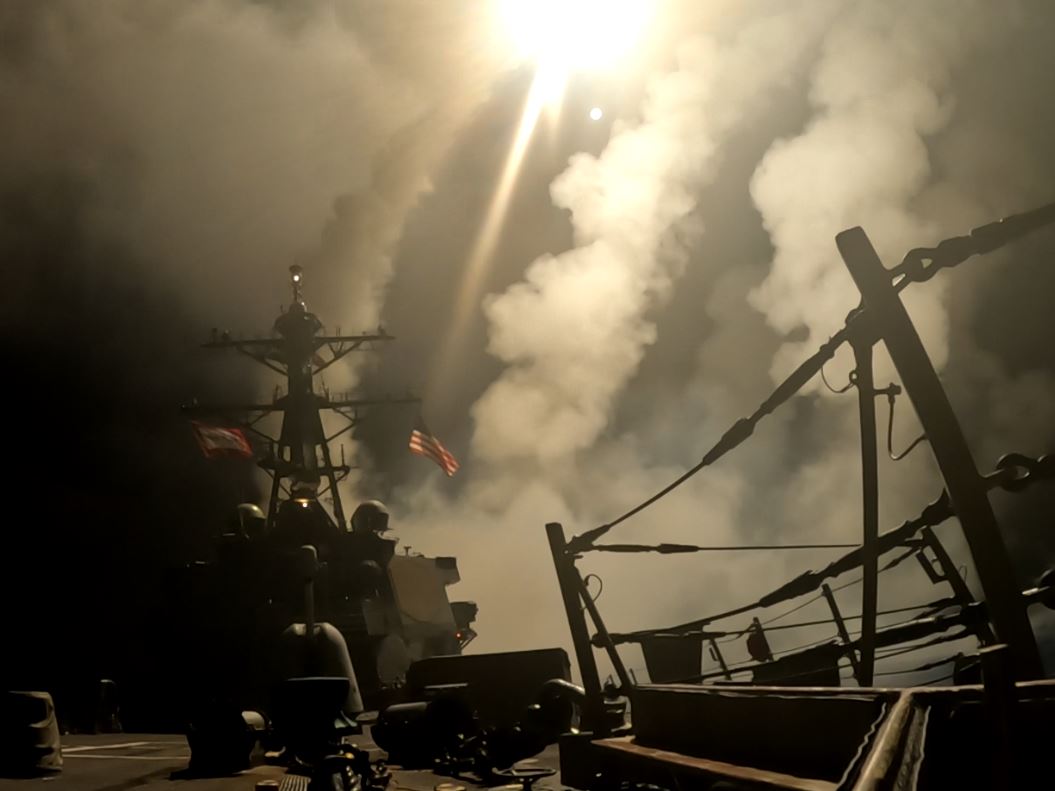
The US air force general Dan Caine, chairman of the joint chiefs of staff, threatened to pursue any Iranian-flagged vessel or any vessel attempting to provide material support to Iran, an effort that would include dark fleet vessels carrying Iranian oil in the Pacific.
In a press briefing Thursday at the Pentagon, US secretary of war Pete Hegseth and air force general Dan Caine, chairman of the joint chiefs of staff, provided an update on the military blockade on the Strait of Hormuz as a power struggle over the crucial oil waterway continues.
On Thursday, Caine told reporters that in addition to the blockade of Iranian ports – aimed at stopping ships of all nations entering or departing Iranian ports – the US forces, through operations and activities in other areas of responsibility, like the Pacific area of responsibility, under the command of Adm. Paparo, will actively pursue any Iranian-flagged vessel – or any vessel – attempting to provide material support to Iran.
“This includes dark fleet vessels carrying Iranian oil. As most of you know, dark fleet vessels are those illicit or illegal ships evading international regulations, sanctions or insurance requirements,” he said at the Pentagon.
Since Monday, the United States has said it’s been enforcing a blockade on all vessels entering and exiting Iranian ports.
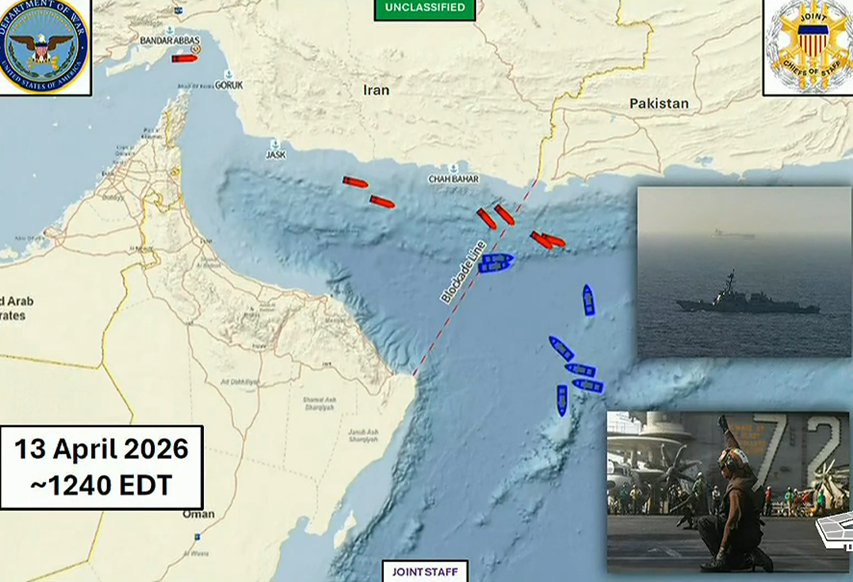
Dan Caine showed a maritime graphic with blue and red boats representing ships in and out of the US blockade on April 13.
‘Turn around or prepare to be boarded’ – Caine reads warning sent to ships in blockade
Caine detailed the Navy transmit warning being given to commercial vessels in breach of the blockade, which reads: “Do not attempt to breach the blocking. Vessels will be boarded for interdiction and seizure transiting to or from Iranian ports. Turn around or prepare to be boarded. If you do comply with this blockade, we will use force.”
On the blockade, he said so far 13 ships have made the “wise choice” of turning around when ordered to do so, adding that the US has not yet had to board any ships.
He added that any vessels who attempt to run the blockade “will be dealt with accordingly.”
The US secretary of war Pete Hegseth speaking at the press briefing at the Pentagon on the US-Israel war with Iran said the US blockade is “the polite way this can go,” and he said that Iran’s energy industry is not destroyed yet.
He pointed out that Iran likes to say it controls the Strait of Hormuz but it does not have a navy. “You cannot control anything,” he said.
He added that Iran is threatening to shoot missiles and drones at commercial ships that are lawfully transiting international waters, but that is not control. “That’s piracy, that’s terrorism,” Hegseth noted.
He also said that the US is maximizing economic pressure across the entire Iranian government.
In a new update, US Central Command (Centcom) said 14 vessels have turned around to comply with the blockade at the direction of American forces after 72 hours of enforcement.
“U.S. forces are focused, vigilant, and highly motivated as they execute a blockade on vessels attempting to enter or exit Iranian ports,” Centcom wrote in a post on X.
Not a big change right now after US blockage: IMO chief says
“Not much has changed, because if we look at the 130 vessels that in average are transiting every day the Strait of Hormuz to the numbers that we have right now, we see that the Strait is actually not open for transit, in respect of the freedom of navigation,” responded IMO secretary-general Arsenio Dominguez to a question by Richard Quest, CNN’s international business correspondent and host of Quest Means Business.
From a legal perspective, in accordance with international law, there is no right to blockage a Strait for international navigation, he told anchor and correspondent Quest.
20,000 seafarers are still stranded in the Persian Gulf.
Dominguez, speaking to Quest, highlighted the urgent need for de-escalation, diplomacy and safe evacuation of ships and seafarers in the Strait of Hormuz while upholding international law.