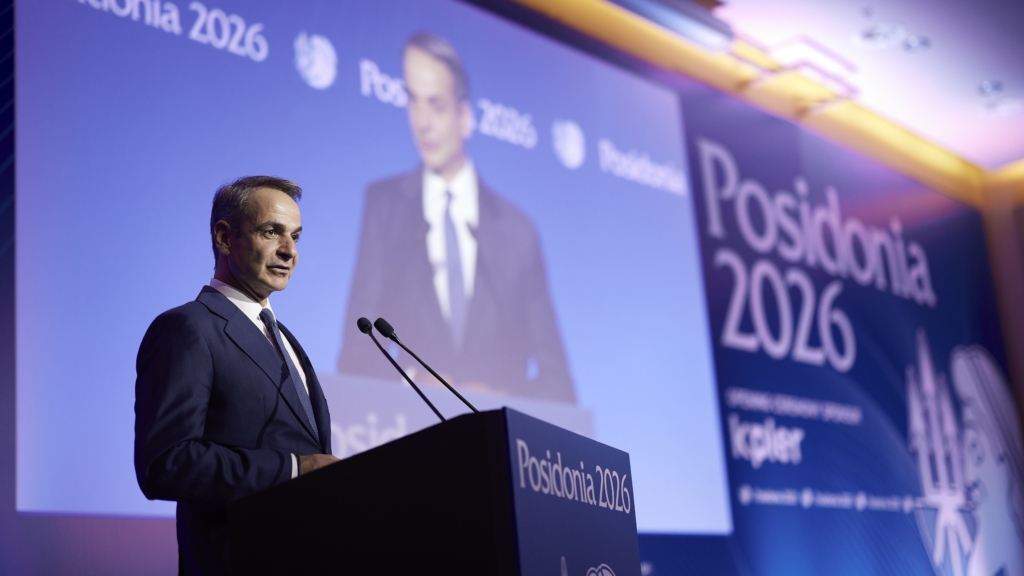
Greek prime minister Kyriakos Mitsotakis underscored the urgent need to fully restore freedom of navigation in the Strait of Hormuz at the opening of the international shipping exhibition “Posidonia 2026,” in Athens, Greece. He directly linked geopolitical stability to the security of sea lanes, stressing that Greece is actively advocating for a return to the pre-crisis status quo in the region: an open, unrestricted waterway where no tolls impede commercial shipping.
In his statement, Mitsotakis referred to the military tensions in the Middle East and their impact on global shipping. According to him, Greece will advocate for “a return to the previous status quo in the Strait of Hormuz,” opposing the introduction of any additional financial burden, tolls or transit fees and insisting that the waterway remain a corridor for free navigation.
“Greece will obviously continue to raise this issue with even greater insistence at the UN Security Council; I remind you, we will once again hold the presidency in October,” he stated.
Even the closure of a single sea route like the Strait of Hormuz, he cautioned, could trigger fuel shortages and inflationary pressures across international markets, and skyrocket transportation costs.
“We know very well that a shock to shipping automatically translates into a global energy shock,” he stated, emphasizing that freedom of maritime transport remains a prerequisite for international market stability.
Greece, at an unsuspected time, a few months ago, had proposed as the central theme of its one-month presidency of the United Nations Security Council, the safety of navigation. This too, unfortunately, proved to be a prophetic choice, he said.
“It is no coincidence that the Greek government decided to actively participate in the operation “ASPIDES” in the Red Sea, in the Gulf of Aden, so that we can effectively protect freedom of navigation,” he noted while discussing the current presence of the frigate Psara in the region.
PM: Green Transition Not to Come at the ‘Expense of Shipping Industry Competitiveness‘
Mitsotakis also referred to the green transition and said that the Greek-owned fleet is already at the forefront of this transformation.
“You know very well that I believe in the green transition. But, at the same time, I am also a pragmatist. The green transition is necessary but under no circumstances can it come at the expense of the shipping industry’s competitiveness and, through it, to society and production. We must, therefore, focus on achievable goals.
“We must intensify our investments in new fuels and new technologies. Knowing, however, that until this transition becomes mature and is promoted on a large scale, we must chart a course that is economically sound and does not place an additional burden on global shipping,” emphasized Mr. Mitsotakis, who said he takes it for granted that the objections of other maritime nations will also be taken into account, during the consultations in the International Maritime Organization (IMO) and in the final agreement.
The prime minister also referred to the investments made by Greek shipowners in the sectors of tourism, energy, banking, and sports that exceed 1.5bn annually, leaving a strong social footprint both collectively and individually. He cited, for example, the reconstruction of approximately 50 schools in Thessaly, investments in hospitals, and emergency aid for national defence and civil protection.
At the national level, he said, this government can be proud of the revival of Greek shipyards. They are creative hubs by the sea that provide jobs and good wages for employees.