Greeks continue investing heavily in newbuild ships and equipment with figures showing that Greek shipowners remain frontrunners in fleet renewal.
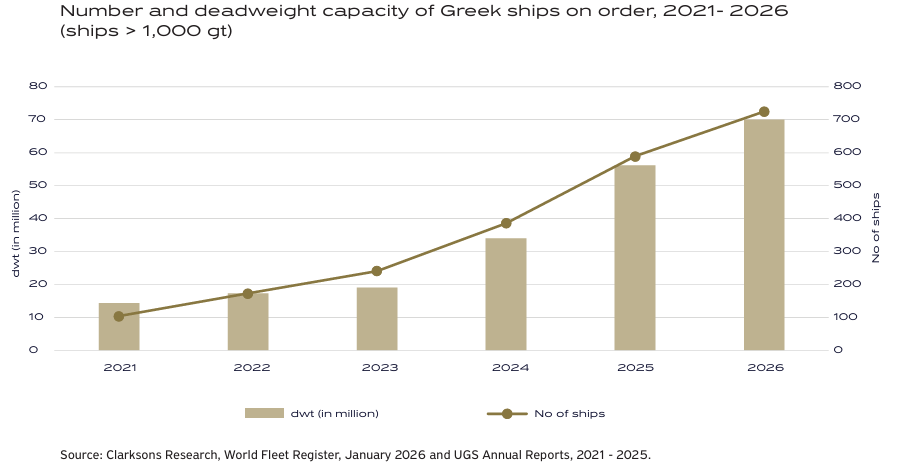
For yet another year, investments by Greek shipowners in newbuildings are increasing. Currently 725 vessels of Greek interests with a total capacity of 70 million dwt – a figure higher by 13 million compared to one year ago – are being built around the world, with a total value of US$60bn.
Compared to 2021, the Greek orderbook is 7 times higher in number of vessels and 5 times higher in terms of capacity.
Greek shipowners continue to invest in various types of vessels focusing on tankers, bulk carriers and LNG carriers, while containership orders are also on the rise.
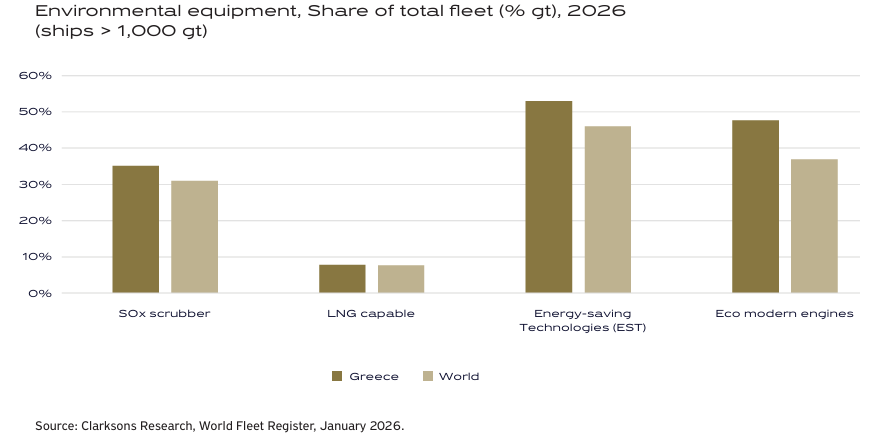
The environmental performance of Greek shipping improves every year, with increasing shares in all equipment categories. For example, while, in early 2024, 1 out of 3 Greek-owned vessels was equipped with at least one energy-saving technology, this share now exceeds 50%.
Greek shipowners focus heavily on bulk carriers, tankers
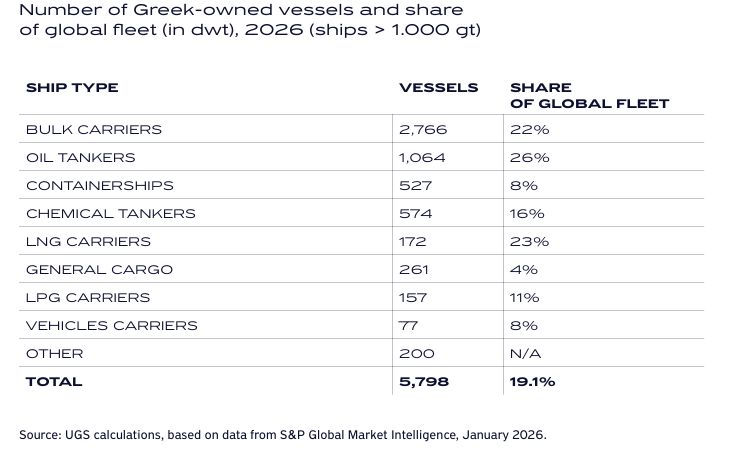
With a fleet of nearly 5,800 vessels, the Greek-owned fleet accounts for 19.1% of the global tonnage and 61% of the EU-controlled merchant fleet, according to the annual report for 2025-2026 of the Union of Greek Shipowners (UGS).
The capacity of the Greek-owned merchant fleet exceeds 458 million dwt.
Greek shipping dominates in several key categories, holding a 22% share of the global fleet in dwt (with 2,766 bulk carriers), a 26% global fleet share (with 1,064 oil tankers), a 8% global fleet share (with 527 containerships), a 16% global fleet share (574 chemical tankers), a 23% global fleet share (172 LNG carriers), a 4% global fleet share (with 261 general cargo), a 11% global fleet share (157 LPG carriers), a 8% global fleet share (77 vehicles carriers), and N/A (200 other). The total number of vessels currently reaches 5,798.
Contrary to its main peers, Greek shipping primarily serves the external trade of other nations. More than 98% of its capacity transports goods from and to third countries. In 2025, Greek-owned vessels made more than 175,000 port calls in 171 countries around the world.
Greek shipping: A national asset
At the same time, Greek shipping remains a national asset for Greece, directly and indirectly accounting for 7-8% of the country’s Gross Domestic Product (GDP) and supporting around 160-200 thousand jobs.
It is estimated that 6% of total private sector jobs in Greece are related to shipping.
Meanwhile, the Greek shipowning community invests almost US$1.5bn mainly in sectors such as real estate, hospitality, energy, banking, media and sports. It also donates US$500m on average each year in support of social welfare initiatives.
New discussions on GHG emissions reduction from ships – What UGS says
The Union of Greek Shipowners in its 2025-2026 report also referred to the new round of discussions on GHG emissions reduction from ships. Following the outcome of the International Maritime Organization (IMO) MEPC 84 in April/May 2026, a new round of discussions on GHG emissions reduction from ships has been initiated.
According to the report, this offers a second opportunity for meaningful dialogue aimed at shaping realistic and practically applicable proposals for reaching a globally accepted agreement.
“Such an agreement should clearly reflect the special characteristics of the shipping industry and the realities of the supply chain,” the reports read, adding that “in the absence of safe, low- and zero-carbon fuels that are available, affordable and scalable worldwide for the sector, its full decarbonisation will remain an unattainable goal.”