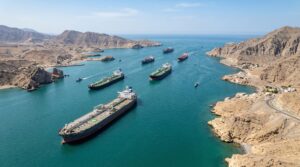
Abu Dhabi National Oil Company (ADNOC) has confirmed that one of its vessels was attacked while transiting the Strait of Hormuz on the evening of Friday, August 14. Fortunately, there were no injuries, and the situation was brought under control.
The attack was the third such incident involving ADNOC vessels in less than a week, and the UAE had also accused Iran of being behind the earlier incidents.
ADNOC has also confirmed that two of its vessels were attacked while transiting the Strait of Hormuz in the evening of Thursday, August 13.
The company has asked the public to rely only on official sources and to avoid circulating rumors or unverified information.
Iran to keep Hormuz closed until US accepts ‘reality of defeat’
Meanwhile, Iran said it will keep the Strait of Hormuz closed until US President Donald Trump “accepts the reality of defeat.”
“This strait will only be closed and opened under Iran’s command,” Iran’s deputy foreign minister for legal and international affairs Kazem Gharibabadi posted on X early on Saturday. “So as long as you do not accept the reality of defeat and stop indulging in illusions, Iran will continue to impose the blockade.”
Trump says Strait of Hormuz will soon be a “territory of the United States”
Trump said that he could soon declare the Strait of Hormuz “a territory of the United States,” as he once again asserted U.S. control of the critical waterway amid the war in Iran.
“After we finish defeating Iran, which is being very badly defeated, pretty soon I’ll be declaring the Hormuz Strait a territory of the United States,” Trump said.
The president also said he has used the military “a little bit more than I wanted to” but argued pressure on Tehran is necessary to prevent Iran from obtaining a nuclear weapon.
“We cannot let Iran have a nuclear weapon,” he said.
Qatar, Bahrain, Kuwait condemn Iranian attack on two UAE-affiliated tankers
Qatar, Kuwait and Bahrain issued statements Friday condemning an Iranian attack on two oil tankers affiliated with the UAE’s (ADNOC) company as they transited the Strait of Hormuz.
Qatar’s foreign ministry said it “strongly condemns the Iranian attack targeting two UAE oil tankers belonging to ADNOC that were crossing the Strait of Hormuz, considering it a severe violation of international law, the freedom of maritime navigation, and a clear violation of UN Security Council resolution 2817.”
The foreign affairs ministry renewed the State of Qatar’s firm rejection of using the Strait of Hormuz as “leverage,” calling in that regard on reopening the strait without conditions.
Kuwait said it offered “full solidarity with the sisterly United Arab Emirates, and its standing by its side in all measures it takes to protect its security, sovereignty, and interests.” It also affirmed the necessity of ceasing all actions that could escalate tensions in the region, respecting the freedom of navigation and safe passage in international waterways, and fully and unconditionally reopening the Strait of Hormuz.
Bahrain’s foreign ministry also said it “stressed the need for the U.N. Security Council to assume its responsibilities in taking firm and deterrent measures to compel Iran to immediately cease all hostile acts, respect freedom of navigation, and ensure the safety and security of commercial vessels in the Strait of Hormuz and other international waterways, and not to use the Strait as a tool for pressure or economic blackmail, considering this a fundamental necessity for preserving energy security and the stability of food and medicine supplies, ensuring the flow of global trade, and consolidating security, stability and prosperity in the region and the world.”
The United Arab Emirates on Thursday said Iran attacked two of its vessels as they transited the Strait of Hormuz, blasting Tehran for what it called “flagrant” maritime violations.
The vessels were targeted in “unprovoked attacks,” the ministry of foreign affairs said. No injuries were reported.
Citing U.N. Security Council Resolution 2817, the ministry described the attacks as acts of piracy by Iran’s Revolutionary Guard Corps.
“The Ministry emphasized that targeting commercial shipping and using the Strait of Hormuz as a tool of economic coercion or blackmail represents acts of piracy by Iran’s Revolutionary Guard Corps, and constitutes a direct threat to the stability of the region, its peoples, and global energy security,” it said.
UAE officials further urged Iran to commit to the complete and unconditional reopening of the Strait of Hormuz and called for the immediate “cessation of all hostilities.”
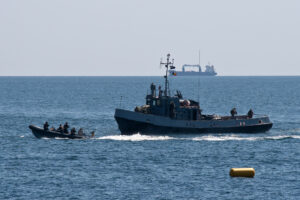
Meanwhile, the U.S. Central Command (CENTCOM) announced that as of Friday, the ongoing U.S. military blockade of Iranian ports has redirected 62 commercial ships.
The effort also disabled three ships, while two were boarded to ensure compliance, according to CENTCOM.
CENTCOM made the announcement as it shared a photo of a U.S. sailor directing an “MH-60R Sea Hawk helicopter during nighttime flight operations aboard guided-missile cruiser USS Princeton,” as the ship sailed in the Arabian Sea and enforced the US blockade against Iran.
Hormuz traffic ‘significantly reduced’ as 20 UKMTO-reported strike incidents since 6: Report
The U.K. Maritime Trade Operations Centre (UKMTO) said Friday that vessel traffic through the Strait of Hormuz remains well below normal levels, with AIS-detected transits approximately 90% below pre-conflict baselines and declining since the 24-26 Jun peak.
The report said the “Southern Omani route remains the highest-risk corridor, accounting for 16 of 18 projectile strike incidents reported by UKMTO since 6 Jul.”
“Behavioural change evident amongst shipping, with multiple vessels aborting planned transits or rerouting North following attacks, indicating risk avoidance rather than route substitution alone,” it continued.
The centre also said overall, there have been “20 UKMTO-reported projectile strike incidents since 6 Jul 2026, resulting in bridge, engine-room, and structural damage across vessels operating in and around the Strait of Hormuz.”