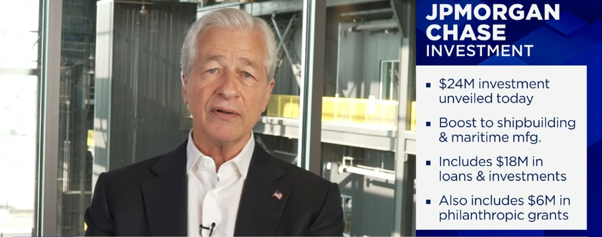
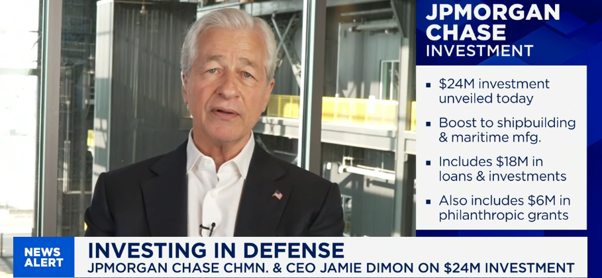
New York-headquartered banking services firm JPMorgan Chase & Co. announced a $24m investment to strengthen Philadelphia’s shipbuilding and maritime manufacturing industry.
The program combines loans, investments, and philanthropic grants to support workforce training, supply chains, and small business suppliers. The figure includes $18m in loans and investments and $6m in philanthropic grants.
A primary focus is accelerating the construction of a new 95,000-square-foot high-bay submarine manufacturing and assembly facility, which is expected to generate 450 permanent jobs.
The capital will also support local maritime small business suppliers and fund workforce training for welders, electricians and other critical shipbuilding roles.
JPMorgan Chase said the near-term focus will include expanding submarine manufacturing and assembly facility, supporting workforce training and apprenticeships, assisting up to 100 local maritime small business suppliers and building stronger coordination among employers, training providers and community partners.
“America can compete and lead in shipbuilding again – it starts with more skilled workers and secure supply chains,” said Jamie Dimon, chairman and chief executive officer of JPMorganChase. “We need to train people for the jobs shipbuilders urgently need, connect them to good careers and strengthen the suppliers and partners that keep a shipyard running. When we build the workforce and the supply chain together, we create good careers for workers and a stronger, more resilient maritime industry that supports our national security and our economy.”
Research from J.P. Morgan’s Industry and Policy Thematics team underscores both the opportunity and the urgency of the challenge. According to the report, less than 1% of new commercial ships are built in the U.S. and less than 1% of the existing global merchant fleet is U.S.-flagged.
Today, the U.S. maintains fewer than 190 flagged merchant vessels – many built abroad – down nearly 3,000 since the 1960s.
A recent report by the JPMorganChase PolicyCenter and Center for Geopolitics further highlights the scale of the workforce gap, estimating demand for 250,000 new skilled shipbuilding workers over the next decade.
The announcement comes as rising geopolitical tensions, including wars in the Middle East and Ukraine, spur governments to rearm and reinvest in domestic industrial capacity.
Speaking with CNBC on July 15, Dimon framed the Philadelphia investments as evidence of a broader American industrial awakening spurred by global instability.
“We’re sitting in the Philadelphia Navy Yard. They built ships here that won the Revolutionary War, that helped win World War II. The arsenal of democracy has been reignited…. there’s 16,000 workers here. That number may very well double over the next 5 years,” Dimon told the network.