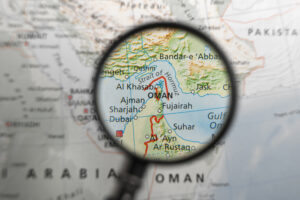
Fox News’ chief political anchor, anchor and executive editor of Special Report Bret Baier scored an extensive sit-down with President Trump, which aired last week. Trump discussed the Iran conflict, gas prices, the Strait of Hormuz and more…
Baier asked the president over high gas prices as the host repeatedly pressed him on soaring gas prices. “Gas prices in America are still high. Painfully high for….” Baier began, before Trump cut him off, declaring, “They’re going to drop like a rock as it’s over.” “The oil goes up but it’s going to come down lower than it was,” he added.
As the exchange grew with both almost speaking simultaneously, Baier stated, “Painfully high though now, and-and could be creeping higher before…,” while Trump interjected, “Well, lower than Biden.”
“It’s very simple. When people hear me say it, everybody agrees, short-term pain. It’s going to be short-term pain,” he explained. “But the pain is much less than people thought. Because people thought that oil would go up to $250.”
“You know, it was $99 yesterday, $99 a barrel. I thought it might go up to 200. I was OK with that, not that I wanted it, but you cannot let them have a nuclear weapon. They will use it on us.”
Trump: Beijing buys large amounts of oil from the region and wants Hormuz open
Trump claimed that Chinese president Xi Jinping told him that Beijing would not provide military equipment to Iran and expressed support for keeping the Strait of Hormuz open.
“When you say ‘support,’ they’re not fighting a war with us or anything,” Trump said when asked if he discussed China’s support for Iran when he met Xi last week in Beijing, during an interview with Fox News.
“He said he’s not gonna give military equipment. That’s a big statement.”
Trump also said Xi told him China wants the Strait of Hormuz to remain open as Beijing buys large amounts of oil from the region.
“He said they buy a lot of their oil there, and they’d like to keep doing that,” said Trump, adding that Xi “would like to see the Hormuz Strait open.”
The president has just wrapped up a high-stakes trip to Beijing, China, where he was welcomed by president Xi amid a blanket of secrecy. The trip drew the attention of the world.
Trump says Xi “likes the idea” of buying US oil
President Trump said to Fox News’ Sean Hannity that Chinese president Xi Jinping “likes the idea” of potentially buying U.S. oil.
“I told him I’d love to see you buy oil from Texas, and Louisiana, from the United States, Alaska, we’ve got so much of it, and he said he likes the idea, he’d like to talk about that,” Trump said. He added, “I think it’ll happen.”
“President Xi would like to see a deal made. He said, ‘If I can be of any help at all, I would like to be of help.’ Anybody that buys that much oil has obviously got some kind of relationship, but he’d like to see the Hormuz Strait open,” he added.
Chinese foreign ministry did not immediately respond to Trump’s claims.
The Trump administration had hoped Xi would use the economic and political leverage to nudge Tehran towards the negotiating table.
Trump in comments to reporters also said that he’s not looking for any favors from China’s Xi on reopening the Strait of Hormuz.
Chinese foreign ministry: ‘The conflict should not have happened’
The Chinese foreign ministry spokesperson Guo Jiakun said Friday that “There is no point in continuing this conflict which should not have happened in the first place” while notably avoiding directly criticising the U.S.
On Iran, the foreign ministry spokesperson said, “To find an early way to resolve the situation is in the interest of not only the U.S. and Iran, but also regional countries and the rest of the world.”
“China’s position on the Iran situation is very clear. The conflict has inflicted severe losses on the people in Iran and other regional countries,” Guo Jiakun noted before President Donald Trump’s departure from Beijing, where he had been meeting with Chinese president Xi Jinping.
“With the spillover still expanding, the conflict has put a heavy strain on global economic growth, supply chains, international trade order and the stability of global energy supply, which hurts the common interests of the international community,” the statement continued.
CENTCOM redirects 81 commercial vessels
U.S. Central Command said Sunday that as of May 17, U.S. forces have redirected 81 commercial vessels and disabled 4 to ensure compliance.
CENTCOM revealed the statistic alongside an image of a U.S. sailor on the bridge of USS Tripoli (LHA 7) while transiting the Arabian Sea.