The UK has said it will contribute drones, advanced Typhoon jets and a warship to a joint mission aimed at safeguarding shipping in the Strait of Hormuz.
Defence Secretary John Healey announced the package at a virtual summit of defence ministers on Tuesday. It includes autonomous mine hunting equipment and cutting-edge counter drone systems, Typhoon jets and the warship HMS Dragon.
More than 40 other nations are involved in the military mission, which Healey said would begin when conditions allow.
The defensive mission is backed by £115m new funding for mine-hunting drones and counter-drone systems, as London seeks to reassure commercial shipping of its commitment to freedom of navigation amid heightened regional tensions.
The Ministry of Defence said the multinational mission – which was announced last month by the UK and France – is strictly defensive and aimed at restoring confidence for commercial shipping along the Strait of Hormuz.
Under the plan, HMS Dragon will be ready for any mission to secure the Strait of Hormuz, the MoD said. British officials highlighted HMS Dragon’s counter drone systems which include the cutting-edge Sea Viper system.
The UK force package will include an autonomous mine hunting equipment to detect and defeat sea mines. It will also include UK Typhoon jets to conduct air patrols over the Strait of Hormuz, and the Royal Navy’s modular ‘Beehive’ system which can deliver high-speed, autonomous Kraken drone boats, allowing the multinational force to sense, track, and identify potential threats and defeat them.
The warship HMS Dragon is already on her way to the Middle East, having undergone additional training and preparation to ensure that her crew are ready.
Britain has more than 1,000 personnel in the region as part of existing defensive operations, including counter-drone teams and fast jet squadrons.
“The UK is playing a leading role to secure the Strait of Hormuz, and we are demonstrating that today with new cutting-edge kit to protect our interests and secure the Strait. With our allies, this multinational mission will be defensive, independent, and credible,” Healey said in a statement.
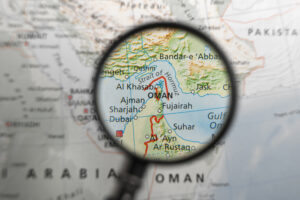
The UK said the multinational plan is designed to restore confidence for commercial shipping along the Strait of Hormuz, one of the world’s most critical trade routes through which a fifth of the world’s oil passes.
France has also announced that it has dispatched the aircraft carrier “Charles de Gaulle” to the Red Sea and the Gulf of Aden to prepare for a future joint mission between Paris and London aimed at strengthening freedom of navigation in the Strait of Hormuz region.
It comes as the Strait of Hormuz remains restricted, and the fallout from the Iran war continues to threaten economic instability around the world.
Iran issues warning to France, UK over warship deployments near Hormuz
Iran’s deputy foreign minister for legal and international affairs Kazem Gharibabadi responded to France and United Kingdom deploying warships near the Strait of Hormuz, warning that they would “be met with a decisive and immediate response from the armed forces of the Islamic Republic of Iran.”
Gharibabadi wrote in a message published on his social media page that “French officials have stated that their deployed warship is tasked with mine clearance and escorting ships once calm is restored. We remind them that, whether in times of war or peace, only the Islamic Republic of Iran can establish security in this strait and will not allow any country to interfere in such matters.”
Iranian deputy foreign minister also said that the U.S. effort, along with some of its regional allies, to propose a draft resolution regarding the Strait of Hormuz at the Security Council reflects a new attempt to alter the nature of the issue.
The United States, alongside Bahrain and its Gulf partners, Saudi Arabia, the United Arab Emirates, Kuwait, and Qatar, drafted a UN Security Council Resolution to defend, as they claim, freedom of navigation in the Strait of Hormuz.
The draft resolution requires Iran to cease attacks, mining, and tolling. It demands that Iran disclose the number and location of the sea mines it has laid and cooperate with efforts to remove them, while also supporting the establishment of a humanitarian corridor.
Gharibabadi said on X that any text that seeks to frame the situation in the Strait of Hormuz without reference to aggression, siege, threats of force, and Iran’s legitimate rights to defend its security and vital interests “will be flawed, biased, political, and doomed to failure from the outset.”